Before looking at any candlestick, get clear about the market you are facing. This article lays out the four major segments of the financial markets: what each one is, who trades there, how the rules differ, and how they influence one another.
Disclaimer: All content on this site is for learning and research only and does not constitute investment advice. Markets carry risk; invest with caution.
1. The Four Markets at a Glance
| Market | What Is Traded | Core Characteristics | Entry Barrier | Who Trades |
|---|---|---|---|---|
| Stock market | Equity in listed companies | Ownership of businesses, long-term value logic | Medium (account needed, share prices can be high) | Retail + institutions + funds |
| Spot commodity market | Physical goods: gold, crude oil, copper, agricultural products | Physical delivery, supply-and-demand driven | Low (buy by gram/barrel/lot) | Consumers, producers, traders |
| Futures market | Contracts on commodities, stock indexes, rates, etc. | Prices agreed for future dates, leverage trading | Medium (margin required) | Hedging firms + speculators |
| Crypto market | Digital assets such as Bitcoin and Ethereum | 24/7, global, never closes, extremely volatile | Low (a few dollars is enough) | Retail + quant funds + miners |
The four markets trade fundamentally different objects: stocks buy you "a piece of a company", commodities buy "the thing itself", futures buy "a forward contract", and crypto buys "an asset on a distributed ledger". The trading logic follows accordingly.
2. The Stock Market
2.1 What It Is
A stock represents an ownership share in a company. Hold 0.001% of a company and you are entitled to that share of its profit distributions (dividends) and voting rights. The long-term driver of a stock's price is the company's earning power.
2.2 Participants
| Participant | Role |
|---|---|
| Listed companies | The sellers issuing shares, raising capital |
| Retail investors | Individual buyers and sellers; a large share of A-share volume |
| Institutional investors | Mutual funds, insurers, foreign capital, pension funds; their share keeps rising |
| Market makers / liquidity providers | Quote both sides of the market and earn the spread |
| Regulators | Securities commissions and exchanges; set rules and disclosure requirements |
2.3 Major Markets and Trading Mechanics
| Market | Ticker | Trading Hours (Beijing Time) | Settlement | Price Limits |
|---|---|---|---|---|
| A-shares (Shanghai/Shenzhen) | 000001.SZ / 600000.SH | 9:30–11:30, 13:00–15:00 | T+1 (shares bought today can only be sold tomorrow) | Main board ±10%, ChiNext/STAR ±20% |
| Hong Kong stocks | 00700.HK | 9:30–12:00, 13:00–16:00 | T+0 (buy and sell same day) | No price limits, but a "market volatility mechanism" exists |
| US stocks | AAPL | 21:30–4:00 next day during DST | T+0 | No price limits; circuit breakers (-7%/-13%/-20%) |
Example: buy 100 A-shares today and you cannot sell today — the earliest is tomorrow (T+1). Hong Kong and US stocks can be bought and sold the same day (T+0).
3. The Spot Commodity Market
3.1 What It Is
Spot commodities are a physical delivery market: buying gold means buying physical gold; buying oil means buying actual barrels. Prices are set by supply and demand — production, inventories, consumption, and geopolitics all move them.
3.2 Participants
| Participant | Role |
|---|---|
| Producers | Mines, oil fields, farms; sell the output |
| Consumers | Smelters, refineries, food processors; buy raw materials |
| Traders / intermediaries | Capture geographic and time spreads |
| Investors | Buy gold, silver, etc. as store-of-value / safe-haven assets |
| Exchanges | Shanghai Gold Exchange (SGE), Shanghai Futures Exchange, London Metal Exchange (LME) |
3.3 Characteristics of Spot Commodities
- Pricing anchor: spot prices are a key reference for global commodity futures prices, and the two influence each other.
- Spot gold/silver is what retail investors touch most often (bars, gold ETFs, paper gold).
- Physical commodity spots (crude, copper, soybeans) see little direct retail participation; most exposure comes through futures or ETFs.
4. The Futures Market
4.1 What It Is
A future is a standardized contract: an agreement to buy or sell something at a set price on a set future date. It was invented for hedging — a farmer locks in the price of grain to be sold three months later and sidesteps falling prices; speculators later flooded in, making futures one of the most active speculative markets.
4.2 Participants
| Participant | Role |
|---|---|
| Hedgers | Real-economy firms (miners, oil companies, airlines, grain merchants) locking in costs or sale prices |
| Speculators | Use margin to control large positions and bet on price swings |
| Arbitrage desks | Capture spreads across expiries, products, and markets |
| Exchanges and clearing houses | Provide matching and central clearing, guarantee contract performance |
4.3 Futures Mechanics (Key Differences from Spot)
| Feature | Description |
|---|---|
| Margin trading | Pay only a fraction of contract value (e.g. 10%) — that is 10x leverage |
| Daily mark-to-market | P&L is settled daily at the close; losses beyond the margin trigger margin calls or forced liquidation |
| Delivery at expiry | Contracts expire; settle physically or in cash — retail traders usually close before expiry |
| T+0 | Open and close within the same day |
| Short selling | Sell first, buy back later — falling prices pay too (routine outside A-share margin trading) |
Futures are a "small lever moves big weight" market: 100,000 of margin controls a 1,000,000 contract. Right direction, fast gains; wrong direction, equally fast losses. That is why this knowledge base gives Futures its own chapter and tags it "Know the risks".
💀 Futures leverage moves big weight — the wrong direction loses just as fast
100,000 of margin controls a 1,000,000 contract. Right direction, fast gains; wrong direction, equally fast losses. Leverage cuts both ways — build your risk literacy before touching futures.
5. The Crypto Market
5.1 What It Is
Cryptocurrencies are digital assets issued on blockchain ledgers. Bitcoin (BTC) positions itself as "digital gold"; Ethereum (ETH) hosts an on-chain ecosystem of DeFi, NFTs, and more. The crypto market has no central exchange for matching (decentralized in design, though most trading routes through centralized exchanges such as Binance/OKX) and trades 24/7, 365 days a year.
5.2 Participants
| Participant | Role |
|---|---|
| Retail traders | Global individuals; extremely low entry barrier |
| Quant / HFT firms | Take the bulk of spot and derivatives volume |
| Miners / validators | Maintain the network and earn new-coin rewards |
| Market makers | Provide liquidity and earn the spread |
| Exchanges | Centralized matching and custody (CEX), or on-chain automated market making (DEX) |
5.3 What Makes Crypto Different
- 24/7, no close: there is no closing price; extreme moves can hit at 3 a.m.
- Extreme volatility: ±10% days are routine; bull markets breed 100x coins, bear markets zero them out just as often.
- Global linkage: crypto spans every time zone; US equity open/close windows often bring the sharpest moves.
- Derivatives dominate: perpetuals offer 100x+ leverage, and liquidation news breaks almost daily.
6. Side-by-Side Comparison of the Four Markets
| Dimension | Stocks (A-shares) | Spot Commodities | Futures | Crypto |
|---|---|---|---|---|
| Trading hours | 4 hours on weekdays | Varies by venue (gold T+D runs ~23 hours) | Day + night sessions (~23 hours/day for most products) | 24/7 |
| T+0 / T+1 | T+1 | T+0 | T+0 | T+0 |
| Leverage | Essentially none (margin trading aside) | None | Yes (margin system, typically 5–15x) | Spot no; derivatives yes (100x and above) |
| Price limits | Main board ±10%, ChiNext/STAR ±20% | Mostly none | Most products ±4% to ±10% | No price limits |
| Minimum trade unit | 100 shares (one lot) | By product (gram/tonne/barrel) | 1 lot (e.g. 10 tonnes/lot) | Fractions like 0.00001 BTC |
| Short selling | Restricted (margin trading) | Hard in spot; possible via gold deferred | Free | Free |
| Delivery / settlement | No delivery concept | Physical spot | Delivery at expiry | Spot none; perpetuals can roll forever |
7. How Markets Influence Each Other
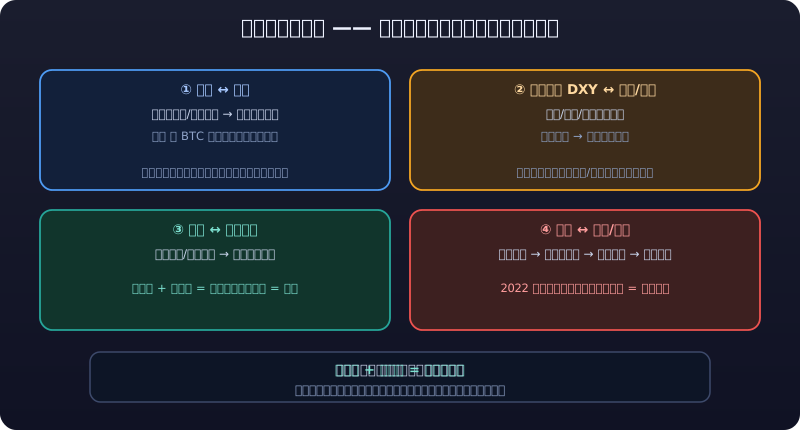
Financial markets are not islands; money flows between them worldwide. The most common linkages worth memorizing:
7.1 US Equities ↔ Crypto
- Crypto volatility usually rises during US equity hours (after 21:30 Beijing time), because US institutional money and quant strategies are most active.
- Fed rate hike/cut expectations → risk assets (US equities, crypto) move together: easing expectations lift both, tightening expectations weigh on both.
- The Nasdaq (tech-heavy) and BTC have shown positive correlation in most years, and are often cross-checked as a gauge of risk appetite.
7.2 US Dollar Index (DXY) ↔ Commodities / Crypto
- Gold, crude, and copper are priced in dollars: a stronger dollar → each dollar buys more commodity → prices under pressure; a weaker dollar → commodity prices benefit.
- Crypto is not fully driven by the same forces, but it moves closely with the macro logic of "dollar liquidity tightening / easing".
7.3 Gold ↔ Risk Assets
- Gold is the classic safe-haven asset: when equities crash or geopolitical conflict escalates, money pours into gold and its price rises.
- A simple risk-appetite gauge: US equities up + gold down = high risk appetite; the reverse = risk-off mode.
7.4 Crude Oil ↔ Inflation / Equities
- Oil is the blood of industry: a big oil rally → rising inflation expectations → central banks more likely to hike → equity valuations pressured.
- The 2022 Russia-Ukraine conflict pushing up crude while global equities sagged is a textbook case of this chain.
7.5 Futures ↔ Spot
- Spot and futures prices of the same product (e.g. gold) anchor each other; the futures price is the market's "forward expectation" of spot.
- Futures premium/discount (the basis) reflects the market's view of what comes next and is the arbitrage desks' main battlefield.
8. Recommended Learning Order in This Knowledge Base
Getting Started (markets and vocabulary)   ← you are here
        ↓
Spot (simplest, lowest risk)               ← learn trade flow and position sizing first
        ↓
Stocks (rules and fundamental analysis)
        ↓
Futures (leverage, margin, forced liquidation)  ← must-read before using leverage
        ↓
Crypto Perpetuals (perpetuals, **<mark>funding rate</mark>**)
        ↓
Technical Analysis (candlestick patterns, indicators, volume-price)
        ↓
Trading System (plan, risk control, psychology)
        ↓
Pitfalls (traps, compliance, exit)
Why this order:
- Start with spot — no leverage, no liquidation; build the right instincts for "buying/selling" and "position size" first.
- Step up to stocks — clear rules and open data make stocks ideal for practicing a fundamentals + technicals framework.
- Leave futures/perpetuals for later — leverage cuts both ways; build risk literacy first. The margin and forced liquidation sections of Futures are required reading in this knowledge base.
- Technical analysis runs throughout — whatever the market, candlesticks and indicators speak the same language; learn once, use everywhere.
Remember one line: learn not to lose before learning to earn. Every article that follows moves you toward that goal.
🎯 Iron rule #1 for beginners: learn not to lose before learning to earn
Learn not to lose before learning to earn. That principle runs through every later chapter — build position instincts with spot, learn fundamental analysis with stocks, master forced liquidation and margin in futures, and only then talk about returns.
⚠️ Risk Warning
Risk levels differ enormously across markets: spot stocks and spot crypto, futures contracts, and margin forex are not in the same league. Before entering any market, make sure you understand its trading rules and its worst-case scenario.