Chapter progress
20 · Classic Reading List (Reading Guide)
The first 19 chapters of this knowledge base have already explained the "methods" thoroughly: how to read candlesticks,
📚 5 lessons
Continue this course
01 · Beginner Books
Next lesson · 20 · Classic Reading List (Reading Guide)
Chapter Intro
title: "Classic Reading List (Reading Guide)" description: "The previous 19 chapters covered the methods; this chapter recommends the books worth reading over and over, organized in five tiers from beginner to close-reading methodology, and tells you why to read each book and how"
20 · Classic Reading List (Reading Guide)
The first 19 chapters of this knowledge base have already explained the "methods" thoroughly: how to read candlesticks, how to define a trading system, how to manage risk, how to read financial statements. But behind every method is a framework, and a framework cannot be reverse-engineered from documentation alone — it needs good books underneath, one after another.
This chapter does not recommend a "100 must-reads" list. It only recommends books worth reading repeatedly, and tells you why to read them and how. The list advances through five tiers — Beginner → Technical → Value → Quant & Psychology → Close-Reading Method — finishing one tier before moving to the next.
Disclaimer: Everything in this chapter is for learning and research only and does not constitute investment advice. The views in these books represent their authors' positions; please read critically. Markets carry risk — invest with caution.
Positioning: The Knowledge Base Covers Methods, Books Help You Build a Framework
text
19 knowledge base chapters        →   One book
  "What it is, how to use it"         "Why, what's behind it, when it stops working"
- The knowledge base solves the "tools": terminology, rules, formulas, checklists — searchable and directly usable.
- Books solve the "philosophy": they stitch scattered knowledge into a worldview — why stop-losses are so hard to execute, why you avoid crowded trades, why the market is a weighing machine in the long run.
- Neither works without the other: only reading without practicing turns books into "I understand the theory"; only grinding docs without reading leaves knowledge scattered — it collapses the moment the market changes.
Five-Tier Reading Roadmap
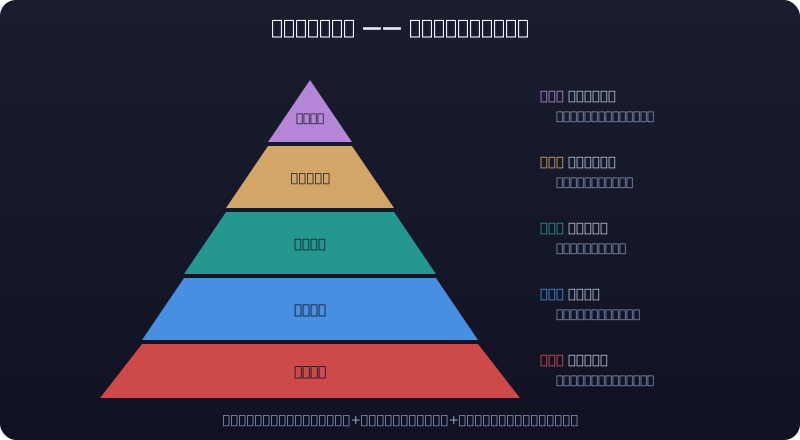
| Tier | Document | Core Goal | Typical Reader |
|---|---|---|---|
| 1 | 01-Beginner Books | Money mindset, asset mindset, indexing thinking | Complete beginners, new to markets |
| 2 | 02-Technical Analysis Classics | Trends, patterns, rule-based trading | Traders and chart watchers |
| 3 | 03-Value Investing Classics | Margin of safety, moats, cycles | Aspiring investors, stock/fund buyers |
| 4 | 04-Quant & Trading Psychology | Human biases, probabilistic thinking, uncertainty | Experienced traders looking to level up |
| 5 | 05-How to Read a Book Closely | Close-reading method, note systems, personal knowledge base | Anyone who wants books to actually stick |
Suggested order: do not start by grinding through The Intelligent Investor or Security Analysis. Finish chapters 01 and 05 first (learn how to read), then pick from 02/03/04 as needed. You don't have to finish all five tiers — short-term traders should focus on 02+04, allocators on 01+03.
How This Chapter Pairs With the Rest of the Knowledge Base
| Reading Chapter | Paired Knowledge Base Chapters |
|---|---|
| 01-Beginner Books | 01-Getting Started, 14-Wealth Allocation |
| 02-Technical Analysis Classics | 06-Technical Analysis, 07-Trading System |
| 03-Value Investing Classics | 18-Financial Statements Deep Dive, 19-Industry Research |
| 04-Quant & Trading Psychology | 07-Trading System, 15-Quant Practice |
| 05-How to Read a Book Closely | All chapters (use whichever pairs with the book at hand) |
How to pair them: read a chapter of a book → compare it against the matching knowledge base chapter → open Kline Buty and verify the book's claims against live market data. However classic a book's example is, nothing beats finding one yourself on a chart. For the detailed method see 05-How to Read a Book Closely.
Conventions
- Book information (titles, authors, core ideas) reflects real published works; reviews aim to be objective — neither hype nor hatchet jobs.
- Every article includes a "⚠️ Risk Warning" — the reading list itself carries no risk; the risk lies in assuming that having read means being able.
- What this series recommends is a starting point for reading lists, not an endpoint. After each article, keep expanding along the authors and references cited.
- Titles differ across simplified Chinese, traditional Chinese, and English editions; this doesn't affect reading — go with whichever edition you can actually get.
Risk Warning
⚠️ Risk Warning: Reading won't make you money directly — if anything, it makes you more careful about money, which is a good thing. The real risks are "reading without doing" — plenty of books consumed, orders still placed on gut feeling, so the reading was wasted — and "reading into obsession," treating one book's conclusions as a universal holy grail. Any book is just one person's summary of experience in one era, in one market; Chinese markets, crypto markets, and leveraged trading can all invalidate a book's conclusions. Treat books as a toolbox, not an instruction manual.
Chapter Contents
经典书单篇 · 随堂测
3 concept questions · instant grading
Lessons
0/5
- 01 · Beginner Books
The first batch of books for complete beginners. This tier's goal is not teaching you how to trade, but building three things: a sound view of money (how money works), a sound view of assets (what is an asset vs. a liability), and a sound view of investing (investing before trading; slow is fast)
- 02 · Technical Analysis Classics
Knowledge base chapter [06-Technical Analysis](../technical-analysis/) has turned candlestick patterns, technical indicators, and volume-price analysis into a searchable checklist. This chapter's mission: put those methods back into the books where they were born, and see each author's original framework…
- 03 · Value Investing Classics
Technical analysis tells you what price is doing; value investing tells you what a thing is actually worth. This tier runs from Graham's The Intelligent Investor through Buffett, Munger, Lynch, and Howard Marks, landing in the Chinese market context — seven books spanning…
- 04 · Quant & Trading Psychology
The first two tiers taught you to read the market; this tier teaches you to read yourself and read patterns along two tracks — trading psychology and quantitative methods
- 05 · How to Read a Book Closely
The previous four chapters recommended 20+ books. But buying without reading and reading without retaining is the trader's most common self-deception — between 'having read many books' and 'having a framework' stands an engineering project called close reading
🤖 AI Chapter Summary
Next chapter →
21 · Behavioral Finance
Every previous chapter answered "what is the market?" This one answers a more fundamental question — why is the market t