The previous four articles covered "selling skills to institutions / turning them into products"; this one covers the last lifestyle: no employer, no startup — living full-time off your own trading system. It is also the road with the heaviest survivorship bias, the most emotionally charged narrative, and the cruelest reality.
This article is not "how to trade full-time" but "the questions you must answer on paper before going full-time": a prerequisite checklist, financial math, income volatility, a day's schedule, psychology and social life, failure-rate reality, and part-time transition.
Prerequisite Checklist Before Going Full-Time
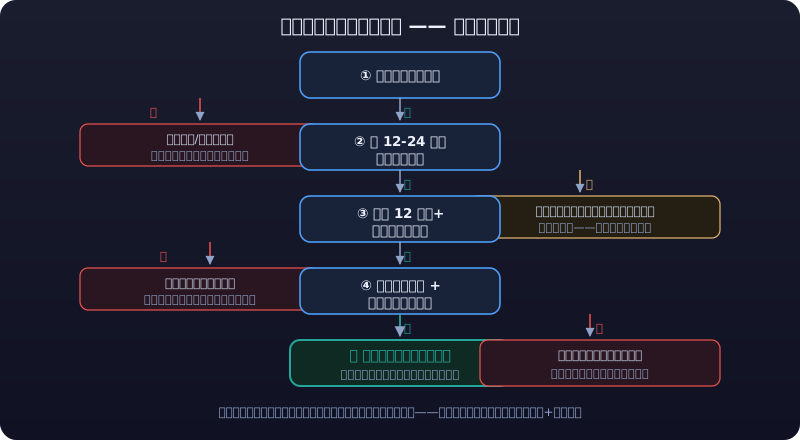
Before quitting to trade full-time, check each item (if even one is missing, don't quit yet):
| # | Prerequisite | Notes |
|---|---|---|
| ① | Verifiable 2-year continuous live track record | Complete statements/equity curve, not screenshots; includes a full trading journal and reviews that others can audit |
| ② | Family emergency fund ≥ 3 years of living expenses | Full-time trading income is uncertain; size the emergency fund for the "worst case", not the "average case" |
| ③ | Spouse/family consensus | Family support is scarcer than capital; forcing full-time trading against family opposition makes trading pressure and family relations detonate each other |
| ④ | Explicit exit criteria | "X consecutive losing months / drawdown hits X% → start job hunting again" — written down, executed on schedule, not left to willpower |
| ⑤ | Cash flow independent of trading income | At least in year one, household expenses don't rely on trading income; trading income is a "bonus", not a "salary" |
| ⑥ | Healthy physical and mental baseline | Chronic insomnia, emotional volatility, and addictive tendencies amplify every full-time trading failure |
The brutal part of this checklist: item ① is a hard gate, and most people quit before they even have a verifiable live record. Achieve ① on small capital first; everything else is just a matter of time.
The First Gate of Full-Time Trading
Item ① is a hard gate, and most people quit before they even have a verifiable live record. "Full-time trading" without two consecutive years of complete statements and review records is essentially substituting courage for mathematics — and the market only accepts mathematics.
How to Use the Checklist
- Every item needs presentable evidence: ① is records your broker/exchange can verify, ② is a bank balance, ③ is a formal family meeting, ④ is a written piece of paper.
- "I'm ready" must survive three follow-up questions: "Where are the records? How many years does the money cover? After a loss, how long until recovery?" If you can't answer, you're not ready.
- The checklist isn't one-and-done: re-review it every six months; items ②③④ can silently expire as life changes (buying a home, having a child, losing a job).
The Financial Math of "Full-Time Trading vs Full-Time Employment"
Basic Formula
Monthly living expenses × 12 = Annual living expenses
Annual living expenses ÷ expected annualized return = Required capital (static)
Worked Example (actual market conditions prevail)
| Monthly expenses | Target annualized | Static required capital | Suggested capital with 20% drawdown buffer |
|---|---|---|---|
| ¥10k | 15% | ¥800k | ~¥1M+ |
| ¥20k | 20% | ¥1.2M | ~¥1.5M+ |
| ¥30k | 20% | ¥1.8M | ~¥2.2M+ |
- Interpretation: at ¥20k monthly expenses targeting 20% annualized, the static requirement is ¥1.2M; but sustaining 20% annualized is already a demanding long-run return (very few individual traders exceed it over the long term), and equity curves inevitably draw down — under the standard "still covers one year of expenses after a 20% drawdown", suggested capital rises above ¥1.5M.
- If the target drops to 10% annualized (a more realistic long-term level), ¥20k monthly expenses need roughly ¥2.4M — this is why the math fails for most people who want to trade full-time.
Also Count These Hidden Costs
- Data feeds, market-data licenses, software and hardware costs.
- Trading costs (commissions/slippage) eroding returns, especially high-frequency small-capital setups.
- Self-paid social insurance/health insurance, opportunity cost (forgone salary and career development) — the latter is the biggest loss and the easiest to ignore.
Dynamic Version: Why "Static Math" Isn't Enough
- The static formula assumes "stable annualized returns", but real equity curves are "profitable months clustered together, unprofitable months stretching long" — budgeting life around 20% annualized breaks the moment you hit a 0% year.
- Dynamic approach: budget using your "worst consecutive 12 months of income" instead of "expected annualized return", and hold an emergency fund sized for the "worst 3 years", not the "worst 1".
- The compound-interest trap: full-time trading is withdraw-only — you take out living expenses every year, so principal stops compounding; "returns must cover living expenses + inflation + trading costs" is the real bar, typically requiring noticeably more capital than intuition suggests.
- Quitting before the math checks out is essentially substituting courage for mathematics — and the market only accepts mathematics.
Income Volatility
- With trading income, budgeting by the "average" is the classic mistake: a strategy averaging ¥10k/month might deliver "8 unprofitable months + 2 months making ¥60k" — budget on the average and you're broke before month nine.
- Reference basis: plan expenses on the worst consecutive 12 months of income, not the mean; assuming "zero trading income" for year one of full-time trading is the safest financial assumption.
- Year-to-year swings are equally huge: bull-market years and choppy years can differ by an order of magnitude; dependence on market conditions exceeds what most traders admit to themselves.
- High income variance → psychological pressure → distorted decisions → even higher variance: the downward spiral of full-time trading usually starts with financial anxiety.
A Day in the Life of a Professional Trader
💡 The First Line of Defense Against Emotional Decisions
This template is reference only — regularity matters more than exact times: a fixed schedule, a fixed process, and a fixed review ritual are the professional trader's first line of defense against emotional decision-making.
| Time slot | Activity |
|---|---|
| Pre-open (30-60 min early) | Read overnight overseas markets and news, confirm today's plan (what to trade, what conditions trigger it, where stop-losses sit), check positions and pending orders |
| Trading session | Execute only planned actions; most of the time is spent waiting — don't watch for opportunities that aren't there; log the reason behind every action |
| Mid-session gaps | Handle messages; don't leave the screen too long; avoid emotionally doom-scrolling |
| Post-close | Daily review: right/wrong on every trade, whether rules were followed, emotional state log |
| Evening | Research and learning: validating new strategies, backtesting, reading (see Reading List) |
| Weekly | Weekly review: tally win rate/risk-reward ratio/drawdown against the weekly plan; check if the system needs adjusting |
| Monthly | Monthly review + archive equity curve + health/sleep self-check |
💡 The Most Important Hour of the Day
The most important hour is writing the plan before the open: watching the market without a plan is gambling; executing with a plan is trading.
Schedule Variants for Around-the-Clock/Multi-Market Trading
| Market | Schedule traits | Watch out |
|---|---|---|
| China A-shares/domestic futures | 4-hour session; closest to an office-worker schedule | Regular hours; good for starting out |
| US stocks/overseas markets | Mostly Beijing-time nights | Circadian disruption harms health; design a fixed sleep schedule deliberately |
| Crypto (7×24) | Never closes; easiest to lose control of | Strongly recommend "sessionizing": trade only inside set windows |
| Multi-market portfolio | Three shifts across morning/afternoon/night | The profile with highest rates of sudden health events and insomnia among full-time traders; be cautious |
The more a market "never closes", the more you need to close it yourself — what separates the professional from the gambler isn't P&L, it's schedule and process.
The Boundary Between Profession and Gambling
What separates the professional trader from the gambler isn't P&L, it's schedule and process. Given identical P&L records, some earned theirs through discipline and some won theirs through luck — stretch the timeline and only the disciplined ones remain at the table.
Psychology & Social Life
Loneliness
- Full-time trading is a one-person office: no colleagues, no meetings, no social structure. Most full-time traders underestimate this.
- Countermeasures: stay active in trading communities/small peer circles, keep a fixed offline sport, and make research/content creation (see Content Creation) a bridge to the outside world.
Comparing Yourself to "Friends Who Make Money"
- In months you earn, friends earn more; in months you lose, friends post their gains — comparison is the everyday source of a trader's mental collapse.
- Countermeasures: compare only with your own equity curve; mute P&L-flaunting feeds (behavioral-finance angle, see Behavioral Finance).
Facing Your Family When Things Fail
- Full-time trading's greatest debt isn't monetary — it's letting down the family who supported you.
- Countermeasures: share your "exit criteria" with family in advance (the contingency should exist before failure); communicate proactively during losing months instead of hiding behind screens; accept that "full-time trading is one way of living, not the measure of your life".
The Reality of "Full-Time Trading Failure Rates"
- Public common-knowledge range (actual market conditions prevail): the overwhelming majority of those who quit to trade full-time return to employment within two years — usually not because they "lost everything", but because of the compounding of "unstable income + psychological drain + opportunity cost".
- "Someone I know made big money trading full-time" is pure survivorship bias: quitters don't post about it, failures don't launch courses.
- The common profile of survivors (checklist): multi-year validated after-hours track record, sufficient capital (mathematically sound), family support, and a clear exit plan — success at full-time trading belongs precisely to those who could stop being full-time at any moment.
- A clear-eyed view of the "full-time trading = financial freedom" narrative: full-time trading is a career choice, not a wealth destination; for most people the right order is financial freedom first, then full-time trading — not the reverse.
Personal Admin Checklist for Full-Time Traders (Easily Overlooked Traps)
| Item | Notes |
|---|---|
| Social/health insurance | How to keep contributing after quitting, and in which city — directly affects medical reimbursement and future pension |
| Tax | Reporting basis for trading/investment income, thresholds and filing method — clarify in advance (subject to local rules) |
| Residence & household registration | Impact of leaving employment on settlement eligibility, home-purchase qualification, etc. |
| Insurance | Reassess critical illness/medical/life coverage after your income structure changes |
| Agreements | Income arrangements with your spouse, independence of the emergency-fund account — agree upfront to avoid later disputes |
💡 The Professional Trader's "Desk"
Most people never consider these items before quitting — then they all erupt at once afterwards. The professional trader's "desk" holds more than market software; it holds a personal-admin checklist.
Exit and Return: Act Two After Full-Time Trading Fails
- Returning to employment isn't failure — it's executing the contingency plan: item ④ "exit criteria" exists precisely so that "going back to work" becomes a planned move rather than flight after psychological collapse.
- Re-entry leverage: trading experience (especially complete statements and reviews) is an asset in the job market — quant roles, broker branches, and risk desks all value "real-world experience" (see Trading Careers Overview).
- The more common form of return: partial return — find a flexible-hours job (consulting, remote, freelance), keep trading and researching after hours, and downgrade "full-time" back to "serious side pursuit".
- Making peace with yourself: failure rates are industry reality, not personal stain; the most valuable asset a departing full-time trader takes away is "a trading system genuinely educated by the market" — it retains its worth in any new role.
Part-Time Transition Plans
If you've read this far and the conditions aren't met, this is the most rational route:
| Plan | Approach | Suited to |
|---|---|---|
| Keep the job + after-hours trading | Daytime work, evening/weekend reviews and research; validate with spare money in small positions | The vast majority of people |
| Quant automation | Turn strategies semi-/fully automatic (see Quant Practice); programs watch the market, human verifies | People who can code |
| Semi-auto + parallel job | Conditional orders/alerts replace watching during workdays; process everything after close | People whose jobs forbid slacking |
| Job → flexible side income → transition | First get content creation/indie development (articles 03/04) generating income, then decide on full-time | Those wanting a gradual exit from employment |
| Partner with institutions | Approach prop/asset managers with results (see Trading Careers Overview); validate yourself with other people's money | People with strong track records but insufficient capital |
💡 The Hidden Advantage of Transitioning Part-Time
The hidden advantage of transitioning part-time: with a salary floor, trading decisions stay calmer, reviews get deeper, and failure costs stay contained — "taking it slow" is almost always the optimal strategy on this path.
Time Budget for Part-Time Traders (Per Week)
| Activity | Hours | Notes |
|---|---|---|
| Trade execution & review | 5-8 | Concentrated in pre-open planning + post-close review; intraday delegated to conditional orders/alerts |
| Research & strategy iteration | 3-5 | Weekend blocks for backtesting and research |
| Learning (books/courses) | 2-3 | See Reading List |
| Journaling & data upkeep | 1-2 | Trading journal, equity-curve updates |
- 12-18 hours per week is a reasonable budget for "keep job + after-hours trading"; more than that starts harming your job; less means you haven't yet matured into a full-time candidate (common-knowledge reference).
- Advancement signals for part-timers: "conditional orders replace screen-watching" plus "two consecutive years of uninterrupted weekly reviews" — only when both hold is it worth reopening the checklist to discuss going full-time.
Common FAQ
| Question | Answer |
|---|---|
| Can I go full-time with small capital? | The math usually doesn't hold (see Financial Math); validate ability on small capital first, accumulate capital second — order cannot be reversed |
| Does simulated trading count as a live record? | No. Simulated accounts lack real psychological pressure and real slippage; use them only to practice process |
| Must full-time trading mean giving up all spending? | The goal is "controlled spending", not asceticism; checklist item ② 's 3-year emergency fund is already sized at your current standard of living |
| Can I trade until I break even, then quit? | No — "quit after breaking even" is the most common excuse that overrides exit criteria; standards written on paper don't bend to emotion |
| What if my family doesn't support it? | Don't go full-time yet. Show them the records and the plan; prove it with time, not with resignation |
Risk Warning
⚠️ Risk Warning
Full-time trading stacks the heaviest triple risk of all career routes: capital risk, psychological risk, and family risk. Financially, most people's capital simply cannot satisfy both demands of "covering living expenses + absorbing drawdowns"; in reality, the overwhelming majority of those who quit to trade full-time return to employment within two years (public common-knowledge range; actual market conditions prevail). "Verifiable 2-year live record + 3-year emergency fund + family consensus + exit criteria" — all four are mandatory; miss any one and keep your job. Treat full-time trading as the outcome of being financially and psychologically ready, never as the starting point of changing your fate.