Mistakes in the market data module cost data quality; mistakes in the trading module cost real money. The trading interface is the part of the whole integration system that least tolerates trial and error: duplicate orders, un-cancellable orders, corrupted state, out-of-order reports — every one of them burns cash directly.
This article starts with interface shapes and works through order types, the state machine, matching principles, lifecycle management, trade reports, reconciliation, and rate limits, ending with a bug list distilled from years of integration scars.
1. Interface Shapes
| Shape | Characteristics | Fits | Representative |
|---|---|---|---|
| REST | Request-response, naturally idempotent for queries; order submission needs "client order ID" idempotency | Low-frequency order submission, queries, reconciliation, admin operations | Binance REST, OKX REST, ordinary brokerage interfaces |
| WebSocket | Long-lived, full-duplex, callback-style push; fits order reports and account updates | Crypto report subscriptions, real-time frontend state | Binance WS user data stream, OKX WS |
| FIX | The financial industry's standard text protocol, fixed field dictionary, widely used between institutions | Overseas markets (CME etc.), institutional connectivity | CME FIX/FAST |
| CTP proprietary binary | C++ DLL, struct messages, callback model; the domestic OMS de facto standard | The mainstream domestic futures path | CTP (see 02-exchanges-oms.md) |
Selection advice:
- Submit orders via REST (crypto) / OMS API (domestic) — queries, amendments, and cancels all have clean request-response semantics, which makes timeout-retry and idempotency tractable.
- Reports must arrive over a push channel (WS/callbacks); never poll for reports — polling's latency and missed-order risk are unacceptable in trading.
- FIX appears only in overseas institutional settings; teams touching it for the first time should simulate the protocol before going live.
2. Order Types at a Glance
| Order type | Definition | Fits |
|---|---|---|
| Limit order (Limit) | Fill at the specified price (or better); fill not guaranteed | The default choice for most strategies; T+1 / price amendment supported |
| Market order (Market) | Fill immediately at the current best price; price not guaranteed | Fast exits, instruments with good liquidity; domestic futures have no standard market order (some OMSs implement "market converted to limit"; per OMS rules) |
| Stop-loss order (Stop) | Converts to market/limit once the trigger price is hit | Breakout entries, risk exits |
| Stop-limit order (Stop-Limit) | Converts to limit after trigger; the spread is protected but may not fill | Want a stop but fear slippage |
| IOC (Immediate-or-Cancel) | Partial fill allowed, remainder canceled immediately | Sniping entries, arbitrage legs |
| FOK (Fill-or-Kill) | Either fill entirely or cancel entirely | Baskets / combination orders, hard constraint on arbitrage legs |
| Iceberg order (Iceberg) | Expose only part of the quantity, hide the rest | Splitting large orders, avoiding impact |
| Conditional order (Conditional / OCO) | A group of conditional orders: when one triggers, the rest auto-cancel | Take-profit + stop-loss both resting; automated exits |
| Best-level order (counterparty's best level) | Submit at the counterparty's best level; unfilled remainder canceled or kept | Common A-share market order types (e.g., "counterparty's best five levels, fill-and-kill the rest"; per exchange rules) |
Two notes: ① Crypto exchange order type names and behaviors (e.g., Binance
STOP_LOSS_LIMIT,TAKE_PROFIT_MARKET) differ greatly from domestic futures — define the mapping per the exchange documentation one by one; ② whether the OMS supports stop-loss orders at all, and what they convert into after trigger, follows the OMS implementation — many domestic OMSs do not support exchange-level stop orders and the client must watch prices and trigger by itself (one of the risk module's duties).
💀 Domestic OMSs don't support exchange-level stop orders — the client must watch them itself
Many domestic OMSs do not support exchange-level stop orders; the client must watch the price and trigger them itself. Relying on the OMS to provide stop orders is handing your life to the other side — the moment the OMS risk layer fails, your stop is just "a line of code". Implement it inside your own system's risk gate.
3. Order State Machine
Regardless of exchange/OMS, the underlying order states reduce to this diagram (state names follow common exchange enums; each exchange's documentation prevails):
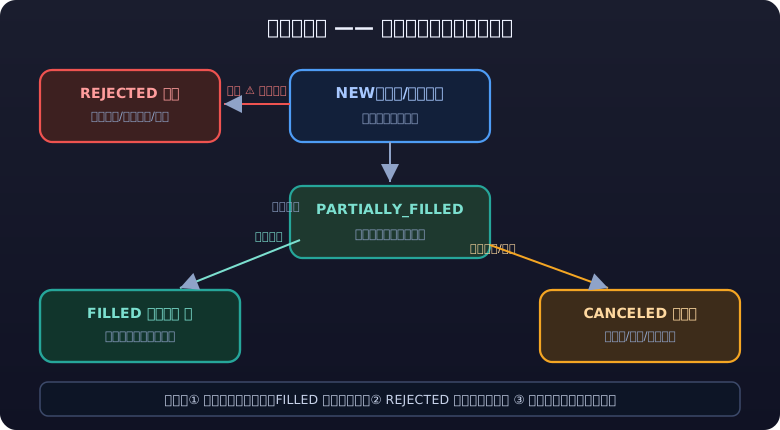
Key states and failure paths:
| State | Meaning | Typical trigger |
|---|---|---|
| NEW | Order accepted, awaiting matching | Normal submission |
| PARTIALLY_FILLED | Partially filled; remainder still resting | Large orders filling in slices |
| FILLED | Fully filled | Normal |
| CANCELED | Canceled | Manual cancel, timeout auto-cancel, remainder canceled after partial fill |
| REJECTED | Rejected — never became an order | Insufficient funds, price out of range, instrument suspended, invalid parameters, rate limit exceeded |
| EXPIRED (common on crypto) | Canceled at expiry without filling | timeInForce was set |
Engineering iron rules:
- States only move forward, never backward: NEW → FILLED is legal; after FILLED an order can never become anything else. Treat any "state rollback" report as an anomaly (alert + freeze the order).
- REJECTED is not a cancellation: a rejected order needs no cancel and cannot be canceled; many bugs come from "running the cancel flow after receiving REJECTED".
💀 Duplicate orders come from blind resends after timeout
Timeout-retry strategy: order request times out → query first, then decide (query-first). "Resend directly on timeout" is forbidden — it is the number one source of duplicate orders. One team's retry logic had no idempotency, and a single network hiccup filled the same order 30 times.
- Cancels have states too: a cancel request can likewise fail (the order just filled) or be rejected; cancel reports (
OrderCancelRejected/ cancel failed) must be handled the same way.
4. Matching Principles
4.1 Price priority, time priority
The core rule of continuous trading: price priority (higher bids / lower asks fill first); at equal prices, first come first served (time priority). This determines:
- A limit order's fill certainty depends on your position in the queue — at the same price, whoever rested first fills first.
- A market order/stop order fills at the counterparty's best price in the queue, which can be far worse than your mental price.
4.2 Call auction vs continuous trading
- Call auction (domestic pre-open): concentrates matching into a single opening price; a single fill price — all buys above and sells below the opening price fill at the opening price.
- Continuous trading (during the session): tick-by-tick matching, price moves in real time.
- Why it matters for integration: some interfaces behave differently during the call auction (e.g., domestic futures call auctions reject market-type orders; crypto has no call auction concept) — code must branch per exchange rules.
4.3 Market makers and order book matching differences
- Futures/stock markets: order book matching; whether you have a counterparty depends on book depth.
- Crypto exchanges: also order book matching, but some venues offer market-maker incentives on specific pairs, and "take-profit/stop-loss" conditional triggers are implemented exchange-side — whether the trigger lives at the exchange or in the client directly decides whether your order can move while you are disconnected.
5. Order Lifecycle Management
5.1 Standard flow
Strategy/user submits intent (instrument, side, quantity, price)
        │
        ▼
Risk pre-trade checks (see 05) — fail → blocked; never enters the order path
        │
        ▼
Create local order (assign local order ID clientOrderId)
        │
        ▼
Call the exchange interface to submit (carrying clientOrderId)
        │
        ▼ request timed out?
        ├── yes → query order status (idempotent confirmation), then decide
        │          "resend / cancel request / mark unknown"
        └── no  → await reports
        ▼
Reports drive state machine updates (NEW → PARTIALLY → FILLED / CANCELED / REJECTED)
        │
        ▼
Trade reports stored + notify strategy + notify frontend
5.2 Idempotency design (the most important part)
- Client order ID (clientOrderId / ClientID): every order request must carry a globally unique local order ID; the exchange binds it to the order. When retrying the same order, use the same clientOrderId — the exchange deduplicates on it (support varies; per exchange documentation), eliminating "network timeout resend creates two orders".
- Cancel idempotency: cancel requests for the same order likewise need a "cancel request ID" for deduplication; duplicate cancels return an error on some exchanges (meaning already-canceled / not-found) — treat that as "idempotent success", not as an exception.
- Timeout-retry strategy: order request times out → query first, then decide (query-first). "Resend directly on timeout" is forbidden — it is the number one source of duplicate orders.
5.3 Local order ID ↔ exchange order ID mapping
- Before submission: the local order ID (clientOrderId) only needs local uniqueness.
- After submission: the exchange returns its order ID (orderId); you must keep a bidirectional mapping persisted — every later query, cancel, and reconciliation uses the exchange order ID.
- Lose the mapping and you can neither cancel nor reconcile — so persist the mapping the moment the submission returns; write to the database first, respond to the user second.
6. Trade Report Handling
6.1 Per-trade vs batch reports
- Per-trade reports (order + trade pushed separately): first the order state change, then the fill details (one order with multiple partial fills pushes multiple trades). Order reports and trade reports are two different things:
OnRtnOrdersays "the order's state",OnRtnTradesays "how much actually filled at what price". - Batch reports (common on crypto): one event carries multiple fills/state changes; handle idempotently (the same report may be re-pushed after a reconnect).
- Handling principle: book positions and funds from trades; book state from orders; align the two by timestamp/sequence number, and self-heal out-of-order cases under the "states only move forward" constraint.
6.2 Tick-level fills vs "last traded price"
- Tick-level fills (trade-by-trade reports): the exact price, quantity, and time of every fill — the basis for booking positions, costs, and slippage analysis.
- "Last traded price" (the latest price in a market data snapshot): an aggregate of the market data layer; not a cost price, and not the price your fill got.
- Common mistake: booking fills at the market's last price → reconciliation never balances. Costs come from reports, never from market data.
⚠️ Costs come from reports, not market data
Booking fills at the market's last price → reconciliation never balances. Costs come from reports, not market data. Tick-level trade reports are the basis for booking positions, costs, and slippage analysis; the "last traded price" in a market data snapshot is an aggregate of the market data layer and must not be used as a cost price.
7. Reconciliation Mechanism
Client local state (positions/funds/orders)
        │
        ▼  periodic (daily after close + intraday sampling)
Exchange/OMS state (query interface)
        │
        ▼
Item-by-item comparison: position qty/avg price, fund balance,
today's order count, fill count
        │
        ▼
Discrepancy → tiered handling: self-healable (missed report → re-pull)
        fixed automatically; not self-healable (money mismatch) →
        freeze related trading + manual intervention
| Reconciliation scenario | When | Handling |
|---|---|---|
| Same-day orders/fills | After close each trading day | Pull all of the day's orders and fills, compare item by item with local records; backfill discrepancies as missed reports |
| Positions | Daily + intraday sampling | Local positions vs OMS positions; on mismatch, suspend trading that contract first |
| Funds | Daily | Investigate balance, frozen, and fee discrepancies one by one |
| Restart recovery | After process restart | Pull the day's full orders/fills/positions to rebuild local state, then resume automated trading (no order submission during recovery) |
Reconciliation is not a launch-day ceremony but a daily automated mechanism with alerts on discrepancies. When reconciliation fails to balance, the only correct action is stop the related trading first, then investigate.
8. Rate Limits and Concurrency
8.1 rate limit rules
| Exchange | Typical limits (official documentation prevails) |
|---|---|
| Binance | Weight-based: each request consumes weight against a per-minute budget (e.g., 6000 weight/min); queries and orders cost different weights |
| OKX | Per-second/per-minute request limits, tiered by endpoint |
| CTP and other OMSs | Usually no published fixed values, but high-frequency order submission triggers OMS/exchange "abnormal trading behavior" monitoring (cancel rate, order-to-cancel ratio out of range) |
8.2 Handling strategy
- Queue: a global request queue + token bucket / sliding window limiter; keep the request rate inside the limit — queue rather than exceed.
- Backoff: on 429/rate-limit errors → exponential backoff retry; do not stack requests while backing off.
- Tiered limiting: order-type requests outrank query-type; a failed query must not affect the order path.
- Multi-account concurrency control: with multiple trading accounts, each account has its own limit while a global queue provides the backstop; prevent "one account rate-limited → whole system times out → reports pile up".
8.3 Rate limits and market data
- Subscription requests share the rate-limit pool with trading requests on some exchanges; a failed market data subscription then drags down trading — subscription management should reuse connections and minimize subscribe requests.
9. Common Integration Bug Checklist
| # | Bug | Cause | Fix |
|---|---|---|---|
| 1 | Duplicate orders | Direct resend after timeout, no idempotency | clientOrderId idempotency + query-first retry |
| 2 | Duplicate cancels | No idempotency key on cancels, or cancel sent again while the report was in flight | Dedup by cancel request ID + treat as idempotent success |
| 3 | Lost state | Some report type unhandled (cancel-reject, expiry); local state stuck at the old value | Full state machine path coverage + daily reconciliation as backstop |
| 4 | Out-of-order reports | Multi-threaded report handling, or old reports interleaving with new after reconnect | One connection one consumer; sort by timestamp/sequence; states only move forward |
| 5 | Booking at market price | Cost taken from last price instead of trade reports | Costs come only from trade reports |
| 6 | Rejection treated as cancellation | Cancel flow still executed after REJECTED | State machine distinguishes REJECTED / CANCELED |
| 7 | Flying blind after restart | Automated trading resumed right after process restart with stale local state | Rebuild state first (pull the day's orders/positions), then resume |
| 8 | Rate-limit meltdown | Everything retried after being rate-limited; avalanche | Backoff + queueing + tiered limiting |
| 9 | Call auction window confusion | Order behavior not branched by exchange session rules | Trading calendar + session state machine (see 02 section 9.3) |
| 10 | Invalid order ID format | clientOrderId used disallowed characters / too long | Validate fields per the exchange documentation before sending |
Risk Warning
⚠️ Risk Warning
Incidents at the trading interface are usually "high frequency × stacked errors": one team misconfigured the price decimals in order parameters at launch and fired thousands of absurdly priced valid orders in a millisecond loop before anyone noticed, by which point they could not all be canceled; another team's retry logic had no idempotency, and a single network hiccup filled the same order 30 times. Remember: every automatic retry must query-confirm first; every parameter change must be validated in simulation and then trial-run with small capital; changing code on go-live day is forbidden. Real disasters are rarely about "how bad one bug was" — they are about "how fast the wrong code ran". Save the speed for the correct system, and install the brakes ahead of every error (risk controls in 05-risk-systems.md).