A stock is a certificate of "company ownership" — buying stock means becoming a shareholder. This article explains from scratch: what a stock is, who is in the market, how a company goes public, what an index represents, how dividends and share distributions are calculated, and closes with one table contrasting the essential differences among stocks, futures, and spot. This is the foundation of the entire stocks chapter.
What Is a Stock
Start with "Raising Money"
A company that wants to expand either borrows (issues bonds) or sells a slice of ownership for cash (issues stock). A stock (Stock / Share) is a certificate of company ownership: the number of shares you hold is the percentage of the company you own (pro-rated over total shares outstanding).
| Concept | Description |
|---|---|
| Stock | A certificate of company ownership, freely tradable |
| Shareholder | Someone who holds stock — one of the company's owners |
| Share capital | The total number of shares a company has issued |
| Market cap | Share price × total shares — the market's "price tag" for the company |
Shareholders' Rights
| Right | Description |
|---|---|
| Dividend right | When the company profits it may pay dividends, distributed by shareholding ratio |
| Voting right | Attend the shareholders' meeting and vote on major matters (electing directors, M&A, etc.) |
| Residual claim | On liquidation, assets left after repaying creditors are distributed pro rata (behind creditors) |
| Pre-emptive right | When new shares are issued, existing shareholders may subscribe first, pro rata |
Types of Stock
| Type | Characteristics |
|---|---|
| Common stock | Voting rights + dividend rights; what A-share retail investors hold is almost entirely common stock |
| Preferred stock | Priority over common stock in dividends and liquidation, but generally no voting rights |
| A-shares / B-shares | RMB-denominated / foreign-currency-denominated common stock (B-shares are marginalized) |
| H-shares / Red chips | Mainland-registered companies listed in HK / offshore-registered Chinese companies listed in HK |
There are only two sources of stock profits: dividends out of corporate earnings + the price spread from rising shares. Any promise of "guaranteed principal and high yield" beyond these has nothing to do with stocks.
📈 Two sources of stock returns: dividends + price spread
There are only two sources of stock profits: dividends out of corporate earnings + the price spread from rising shares. Anything else promising "guaranteed principal and high yield" does not belong to stocks — the extra part is usually a scam.
Stock Market Participants
| Participant | Role | Characteristics |
|---|---|---|
| Retail investors | Individual investors | Most numerous, small share of capital, clear disadvantages in information and tools |
| Institutional investors | Mutual funds, private funds, insurers, social security, QFII, etc. | Large capital, strong research, strict risk control — the market's main pricing force |
| Market makers | Brokers quoting both sides of a stock | Earn the bid-ask spread, provide liquidity; common on the STAR Market and in US stocks |
| Hot money | Short-term speculative funds | Chase themes and limit-up stocks, manufacture short-term volatility |
| Listed companies | The issuers of stock | Grow through financing, bound by disclosure obligations |
| Exchanges | The venues that organize trading | SSE, SZSE, BSE, HKEX, US exchanges — they set the trading rules |
| Regulators | The CSRC and exchange self-regulation | Govern issuance, disclosure, violations, and delisting |
The Issuance Process (IPO) and the Primary vs Secondary Markets
Primary and Secondary Markets
| Market | Definition | Participants |
|---|---|---|
| Primary market | The new-issue market — the company sells shares directly to investors | Issuers and subscribers |
| Secondary market | The circulation market — shareholders trade among themselves | All investors (exchanges) |
IPO subscription earns the spread from "primary-market offer price → secondary-market listing price"; under the registration-based system new shares can break the issue price, so this spread is no longer guaranteed money.
The Full IPO Flow (A-Share Example)
① Restructuring & tutoring → ② Filing & acceptance → ③ Review & inquiries → ④ Registration/approval → ⑤ Pricing → ⑥ Subscription & allocation → ⑦ Listing
| Step | Description |
|---|---|
| Restructuring & tutoring | Shareholding reform; hire the sponsor, accountants, and lawyers |
| Filing & acceptance | Submit the prospectus and other materials to the exchange |
| Review & inquiries | Multiple rounds of exchange inquiries expose weaknesses and doubts |
| Registration | CSRC registration takes effect (main boards follow this flow too since full registration reform) |
| Pricing | Inquiry-based pricing, dominated by institutions |
| Subscription & allocation | Online IPO subscription (retail) + offline placement (institutions) |
| Listing | Tradable from the first listing day |
Listing Thresholds (SSE / SZSE / BSE)
| Board | Positioning | Rough financial threshold (simplified) |
|---|---|---|
| SSE Main Board | Large-cap blue chips, mature companies | Sustained profits; cumulative net profit of 150+ million CNY over the last three years |
| SZSE Main Board | Large-cap blue chips | Same as above (merged with the SME Board in 2021) |
| ChiNext | Growth-stage innovators | Two tracks: profitability, or revenue + R&D |
| STAR Market | Hard-tech companies | Unprofitable companies and special structures (dual-class) allowed |
| BSE | Innovative SMEs | Lowest threshold; most migrated from the NEEQ Selection Layer |
The above is a teaching approximation — always defer to the exchange's latest listing rules.
Stock Indexes
What an Index Is
An index = the rule-based weighted price of a basket of stocks, representing "how a class of stocks moves overall". An index carries no trading costs; it reflects quotes only.
Major A-Share Indexes
| Index | Code | Constituents | What it represents |
|---|---|---|---|
| SSE Composite | 000001 | All SSE-listed stocks | The broad SSE market — what old hands call "the index" |
| SZSE Component | 399001 | 500 SZSE sample stocks | The overall SZSE market |
| CSI 300 | 000300 | Top 300 SSE+SZSE stocks by cap and liquidity | A-share blue chips; the mutual-fund benchmark |
| CSI 500 | 000905 | Next 500 by cap after excluding CSI 300 | Mid caps |
| CSI 1000 | 000852 | 1,000 stocks after excluding the top 800 | Small caps |
| ChiNext Index | 399006 | Top 100 ChiNext by cap | Growth/innovation style |
| STAR 50 | 000688 | Top 50 STAR Market by cap | Hard-tech style |
Major HK and US Indexes
| Index | Constituents | What it represents |
|---|---|---|
| Hang Seng Index (HSI) | ~80 HK-listed blue chips (HSBC, Tencent, Alibaba, etc.) | The bellwether of the HK market |
| Hang Seng Tech Index | 30 HK-listed tech leaders | HK tech style |
| S&P 500 | 500 large US companies | The US market overall; the global allocation benchmark |
| Nasdaq Composite | All Nasdaq-listed stocks | Extremely tech-heavy |
| Nasdaq 100 | Top 100 Nasdaq by cap (ex-financials) | Tech giants like Apple, Microsoft, Nvidia |
| Dow Jones Industrial Average | 30 blue chips | The oldest; limited reference value |
Using Indexes and Their Limits
- A rising index ≠ every stock rising: on a day CSI 300 is up, 3,000 small names may still be falling.
- To read a "structural market", watch the divergence among the SSE Composite, the ChiNext Index, and CSI 1000 together.
- Index funds (ETFs) are among the cheapest and most hands-off ways for ordinary people to participate in the stock market.
Dividends and Share Distributions
The Four Methods
| Method | Essence | Where the money comes from |
|---|---|---|
| Cash dividend | The company pays out profits in cash | Undistributed profits |
| Bonus shares | Undistributed profits converted into share capital and given to you | Undistributed profits |
| Capitalization issue | Capital reserve converted into share capital and given to you | Capital reserve ("other money" on the books) |
| Rights issue | New shares sold to existing shareholders at a discount, pro rata | Existing shareholders pay in |
Dividends are not free money: after the payout the price adjusts down for ex-dividend/ex-rights, and your total assets (shares + cash) are unchanged on the ex-dividend day. Many people think "dividend = profit", but dividend returns come from the company's sustained earnings — not from the ex-dividend day itself.
💰 Dividends are not free money — total assets are unchanged on the ex-dividend day
Dividends are not free money: after the payout the price adjusts down for ex-dividend/ex-rights, and your total assets (shares + cash) are unchanged on the ex-dividend day. Many people think "dividend = profit", but dividend returns come from sustained corporate earnings, not from that one day.
Ex-Divididend and Ex-Rights
| Key date | Meaning |
|---|---|
| Record date | Only holders who still own the shares at the close qualify for this payout |
| Ex-dividend/ex-rights date | The day the price adjusts down; usually the day after the record date |
| Ex-dividend price | Previous close − cash dividend per share |
| Ex-rights price | Previous close ÷ (1 + bonus/capitalization ratio) |
| Ex-dividend & ex-rights price | (Previous close − cash dividend) ÷ (1 + bonus/capitalization ratio) |
Example: the price is 10 CNY, with 2 CNY paid per 10 shares plus 3 bonus shares and 2 capitalization shares (5 extra shares in total):
Ex-dividend & ex-rights price = (10 − 0.2) ÷ (1 + 0.5) ≈ 6.53 CNY
Dividend Tax (differentiated by holding period)
| Holding period | Tax rate |
|---|---|
| ≤ 1 month | 20% |
| 1 month ~ 1 year | 10% |
| > 1 year | Exempt |
Note: since June 2023, capitalization issues also count as "deemed dividends" for tax (previously capital-reserve capitalization could be temporarily exempt); bonus shares and capitalization issues are both taxed at par value, and actual rules follow the tax authority's latest interpretation. For short-term traders harvesting dividends, the tax can exceed the payout.
Gap Filling vs Gap Falling
- Gap filling: the price climbs back after the ex-rights/ex-dividend adjustment — you collect both the dividend and the spread, a sign the market endorses the company's value.
- Gap falling: the price keeps sliding after the adjustment — your "dividend" is a bookkeeping number while total assets shrink.
Stock Code Conventions
A-Share Code Prefixes
| Prefix | Board | Example |
|---|---|---|
| 600 / 601 / 603 / 605 | SSE Main Board | Kweichow Moutai 600519 |
| 688 / 689 | STAR Market (689 = CDR depositary receipts) | SMIC 688981 |
| 000 / 001 / 002 | SZSE Main Board (002 was the SME Board, now merged) | Ping An Bank 000001 |
| 300 / 301 | ChiNext | CATL 300750 |
| 830 | BSE | BTR New Material 835185 |
| 900 prefix | SSE B-shares | — |
| 200 prefix | SZSE B-shares | — |
HK and US Stocks
| Market | Rule | Example |
|---|---|---|
| HK stocks | 5 digits; a 4-digit + letter code is a temporary new-listing code | Tencent Holdings 00700 |
| US stocks | Letter tickers, no unified rule | AAPL, TSLA, BABA (ADR) |
Stocks vs Futures vs Spot Comparison
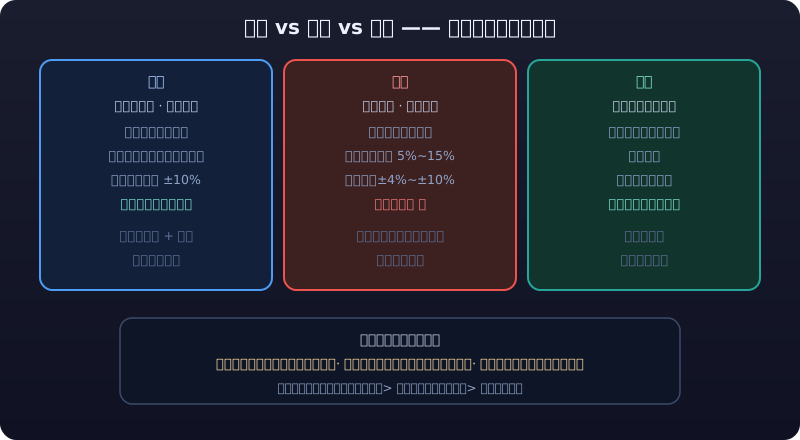
| Dimension | Stocks | Futures | Spot |
|---|---|---|---|
| Underlying | Company equity | Standardized contracts (commodities/indexes/rates) | Physical commodities/crypto |
| Essence | Ownership certificate | Forward contract, a two-way bet | Cash for goods on the spot |
| Shorting | Margin short (high threshold, hard in A-shares) | Naturally possible | Generally long-only (crypto can short via futures) |
| Leverage | None (except margin trading) | Margin of 5%-15%, naturally high leverage | None |
| Term | No expiry, can hold forever | Has an expiry, requires rollover/delivery | No expiry |
| Price limit | Yes (main board ±10%, etc.) | Varies by product (mostly ±4% to ±10%) | None |
| Blow-up | No blow-ups (at worst stuck underwater) | Blow-ups trigger forced liquidation | No blow-ups |
| Return sources | Dividends + price spread | Price spread (largely zero-sum) | Price spread |
| Entry threshold | 100 shares per lot, a few hundred CNY to start | Thousands of CNY margin per lot | Lowest |
| Risk level | Medium | High | Low |
⚠️ Risk Warning
⚠️ Risk Warning
Stocks come with no "principal protection" promise; price swings are the norm, and individual names can slide for years — even to zero — on deteriorating fundamentals, accounting fraud, or delisting. Chasing hot stocks at highs and going all-in on a single name are the most common ways retail investors lose money. This article is educational only and does not constitute investment advice. Before any investment decision, assess your own risk tolerance first, and study Article 04 "Stock Analysis Methods" before acting.