"Is this platform trustworthy?" "Is this firm a real, licensed player?" — the answer isn't in the advertising; it's in the licenses. Financial licenses are the moat of financial companies and the only hard yardstick traders have for telling "who is legit". This article explains China's financial license landscape, broker/futures/fund sub-qualifications, and overseas licensing systems (Hong Kong Type 1–13, US FINRA/SEC), then teaches you to verify any institution on official websites in three minutes.
⚠️ Risk Warning
This article is an objective compilation of public knowledge, for study and research only, and does not constitute legal advice. License categories, application requirements, and regulatory rules change continuously — all specifics are subject to the latest regulations. Holding a license does not mean no risk; judge holistically based on platform history and product risk.
1. China's Financial License Landscape
1.1 Major Licenses at a Glance
| License | Issuer | Business | Relative Barrier |
|---|---|---|---|
| Banking license | NFRA | Taking deposits, issuing loans | Extremely high |
| Securities license | CSRC | Securities brokerage, underwriting, asset management, proprietary trading | High |
| Fund license (public) | CSRC | Public fund raising and management | High |
| Fund registration (private) | AMAC filing system | Private fund managers | Medium (filing-based) |
| Futures license | CSRC | Futures brokerage, consulting, asset management | High |
| Insurance license | NFRA | Life / property insurance | Extremely high |
| Payment license | PBOC | Payment institutions (non-bank payments) | High |
| Micro-lending license | Local financial regulators | Small-scale lending | Medium-low |
| Financing guarantee / leasing | Local financial regulators | Finance-like businesses | Medium-low |
Common sense: a license's essence is "franchise rights + conduct constraints" — you can't just open one, and once open you must operate by regulatory rules.
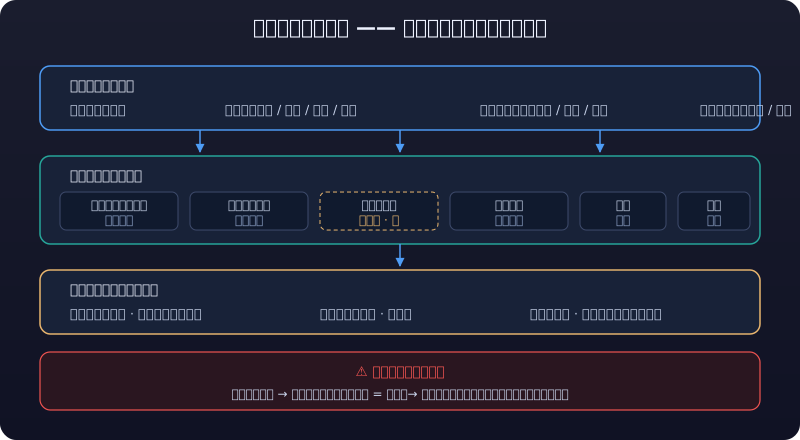
💡 Official website checks are always free and authoritative
Any "legitimacy" can be packaged, but official website verification is always free and authoritative. Spending three minutes verifying the license number, the receiving account, and penalty records beats spending a night on complaint hotlines after losing money.
1.2 Why "A License Is a Financial Company's Moat"
| Dimension | Explanation |
|---|---|
| Scarcity | Approval-based supply keeps licenses limited, especially banking, securities, insurance |
| Capital barriers | Registered capital often runs from hundreds of millions to billions of yuan; newcomers struggle to enter |
| License premium | A securities brokerage license can be worth far more than the company's book net assets (the so-called "shell price") |
| Conduct constraints | Licensed firms must stay continuously compliant; violations bring downgrades, business suspensions, even revocation |
| For users | License = funds have a regulatory backstop (bank tri-party custody, client margin monitoring) |
⚠️ Reverse common sense: a license doesn't directly protect users
The moat protects the licensee, not users directly — a license guarantees "legitimate operation", never "no losses". You check licenses to avoid scammers, not to trust blindly.
2. Brokerage License Sub-Qualifications
2.1 Four Core Business Qualifications of Securities Firms
| Qualification | Content | Typical Clients |
|---|---|---|
| Securities brokerage | Buying/selling stocks/funds/bonds for clients, charging commissions | Retail and institutional |
| Underwriting & sponsorship (investment banking) | Helping companies IPO, refinance, merge; heavy sponsor liability | Listed companies |
| Proprietary trading | The broker investing its own money | The broker itself |
| Asset management | Discretionary wealth management (asset management plans/public fund subsidiaries) | High-net-worth and institutional |
2.2 Broker Classification and Regulation
- The CSRC rates brokers by risk management capability and compliance record (AA, A, BBB…C); ratings affect business scope and contributions to the investor protection fund.
- Investment banking projects carry joint liability: sponsors bear joint responsibility for disclosure fraud (significantly strengthened under registration reform).
- Brokers must also meet net capital and risk control indicator requirements — regulators use capital constraints to limit risk expansion.
What this means for retail investors: choosing a highly rated, listed, long-established top broker is essentially choosing a counterparty with thicker capital and risk control; but trading experience and commission rates matter too — high rating does not mean low fees.
3. Futures Company Licenses and Classified Supervision
3.1 Futures Business Scope
| Business | Notes |
|---|---|
| Commodity futures brokerage | Basic business; nearly all futures companies have it |
| Financial futures brokerage | Requires separate approval |
| Futures investment consulting | Strategy advice (distinguish from "signal calling": licensed consulting ≠ pump groups) |
| Asset management | Futures asset management plans |
| Risk management subsidiaries | OTC options, basis trading, warehouse receipt services (institutional-facing) |
3.2 Classified Supervision
- The CSRC/China Futures Association rate futures companies in classes AA through D; higher classes unlock more innovation businesses.
- Futures companies are also subject to net capital regulation: margin scale is tied to their net capital, capping each firm's total risk capacity.
- Client margins are held under independent custody (monitored centrally by the China Futures Market Monitoring Center) — client funds are not in the futures company's own accounts; this is the industry's most fundamental safety design.
4. Public vs Private Fund Licensing
4.1 Public Funds
| Dimension | Content |
|---|---|
| Regulator | CSRC approval (public fund license); raises from the general public |
| Barriers | Rigorous review of shareholder strength, registered capital, investment teams, risk systems |
| Products | Equity/bond/money market/balanced/ETF/index funds |
| Distribution | Sold to the mass market via banks, brokers, internet platforms |
| Character | Strong disclosure (daily NAV, quarterly/annual reports), tight operation rules (investment scope and ratio limits) |
4.2 Private Funds (Filing-Based)
| Dimension | Common-Sense Points |
|---|---|
| Regulator | AMAC registration and filing system: manager registration + product filing, not approval-based |
| Registered capital | Registration requires paid-in capital above a threshold (historically RMB 10 million; see current AMAC registration guidelines) |
| Personnel | Must hold sufficient certified staff (fund practitioner qualifications) plus compliance/risk officers |
| Qualified investors | Minimum investment typically RMB 1 million per product; personal financial assets ≥ RMB 3 million or average annual income ≥ RMB 500,000 over 3 years |
| Sales restrictions | No public solicitation; only qualified investors may be approached |
⚠️ Common-sense reminder: filing is not regulatory endorsement
- Private ≠ an "upgraded" public fund: private funds carry high thresholds because risk is high, not because returns are high.
- "Filed" does not mean "endorsed": AMAC filing proves formal compliance only — product risk and losses receive no protection whatsoever because of a filing. Many collapsed private funds had filing numbers (see the collapse playbook in Chapter 08 · Pitfalls).
- First step when encountering a "private product": check the manager's registration status, abnormal-operation records, and related-party penalties on the AMAC website.
5. Overseas Licenses
5.1 Hong Kong SFC Regulated Activity Licenses in Detail
| Type | Regulated Activity | Plain-Language Meaning |
|---|---|---|
| 1 | Dealing in securities | Stock brokerage |
| 2 | Dealing in futures contracts | Futures brokerage |
| 3 | Leveraged foreign exchange trading | FX margin trading |
| 4 | Advising on securities | Stock advisory |
| 5 | Advising on futures contracts | Futures advisory |
| 6 | Advising on corporate finance | Investment banking/sponsorship |
| 7 | Providing automated trading services | Electronic trading platforms |
| 8 | Securities margin financing | Margin (financing) lending |
| 9 | Asset management | Discretionary wealth management |
| 10 | Providing credit rating services | Credit rating |
| 11 | OTC derivatives trading | OTC derivatives |
| 12 | OTC derivatives clearing | OTC clearing |
| 13 | Alternative asset funds (proposed) | Alternative assets |
Note: Hong Kong currently recognizes Types 1–12 as regulated activities; Type 13 ("alternative asset funds") is proposed — implementation timing is subject to the latest SFC announcements.
Verification: the SFC's Public Register shows licensed corporations' and individuals' license status, categories, and disciplinary records — a must-check before opening an HK/US brokerage account.
5.2 US FINRA Exam Basics
| Exam | Plain-Language Meaning | Common Among |
|---|---|---|
| Series 7 (General Securities Representative) | Core brokerage qualification: may sell stocks/funds/options etc. | Broker representatives |
| Series 63 (State Securities Law) | State securities law compliance knowledge | Broker representatives (required by most states) |
| Series 65 | Investment adviser exam (RIA personnel) | Investment advisers |
| Series 66 | Combined 63+65 | Broker-representative advisers |
| Series 3 | National Commodity Futures exam (NFA-related) | Futures brokerage |
| Series 24 | General securities principal | Broker management roles |
Common sense: FINRA registrants can be looked up at FINRA BrokerCheck (brokercheck.finra.org) — disciplinary history, complaints, penalties. It's the public channel for checking whether your US stock broker is reliable (also proactively check a broker's SEC/FINRA registration status when opening an account).
5.3 SEC RIA (Registered Investment Adviser)
| Dimension | Content |
|---|---|
| Concept | Registered Investment Adviser: firms giving advice under a "fiduciary duty" (private client asset management, advisory) |
| Registration | Firms above a certain AUM threshold (on the order of USD 100 million; per SEC rules) register with the SEC; smaller ones with states |
| Fees | Typically charge management fees on AUM rather than trading commissions |
| vs broker-dealers | Brokers "execute trades" (Reg BI best interest); RIAs "manage assets" (fiduciary duty) — stricter conflict-of-interest disclosure |
6. "Buying a Shell vs Applying for a License": The Reality
6.1 Comparing Two Paths
| Path | Cost | Time | Risks |
|---|---|---|---|
| Applying directly | Heavy capital + compliance investment | Long (months to years) | Approval uncertainty |
| Acquiring a licensed company (shell purchase) | Hundreds of millions to billions (securities/futures) | Fast | Shell's historical compliance issues, liabilities, legacy penalties |
Common sense: buying a shell is essentially purchasing the "scarce administrative permit" itself — regulators also approve ownership changes, so buying a shell doesn't automatically transfer shareholders. History offers plenty of cases of "buy shell, then blow up", because shell buyers often arrive with leverage and aggressive business ambitions.
6.2 Common Disguises of Unlicensed Operation
| Disguise | Truth |
|---|---|
| "We run on some licensed broker's white label" | May merely rent a channel; fund custody and compliance responsibility unclear |
| "Overseas license, domestic operations" | Domestic unlicensed operation violates regulations outright (see crypto-regulation.md) |
| "Application in progress" | Applying ≠ licensed; regulated business before licensing is prohibited |
| Stolen/counterfeited license numbers | Instantly exposed by checking official websites |
7. What It Means for Traders: Identifying Licensed Institutions in Three Minutes
7.1 Official Verification Channels
| What I Want to Verify | Where to Check |
|---|---|
| Is a broker/futures company/fund manager licensed | CSRC website "Regulatory Information Disclosure" → list of securities and futures institutions |
| Is a private fund manager registered | AMAC website (amac.org.cn) |
| Banks/insurers/payment institutions | NFRA website, PBOC website |
| Hong Kong licensed institutions | SFC Public Register |
| US brokers/advisers | FINRA BrokerCheck, SEC website |
| US futures brokers | NFA BASIC database |
7.2 Five-Step Verification Method
- Match the license number: the institution's full name and license number on official records must match exactly what they claim.
- Match the entity: the receiving account must belong to the licensed institution itself — never personal accounts or third-party collectors.
- Check records: look for administrative penalties, disciplinary actions, abnormal operations (especially for private funds).
- Check the domain: official domain must match the registered entity; fake sites often differ by one letter.
- Reverse verification: search suspicious platforms by name on regulator websites — no hit or mismatch means automatic veto.
💡 Final common sense: three minutes of verification beats after-the-fact recourse
Any "legitimacy" can be packaged, but official website verification is always free and authoritative. Three minutes of checking beats spending all night on complaint calls after losing money.
8. License Quick Reference
| Identity I See | Corresponding License/Registration | Verifier |
|---|---|---|
| Mainland broker | Securities business license | CSRC |
| Mainland futures company | Futures business license | CSRC |
| Private fund | Private manager registration | AMAC |
| HK/US broker (HK entity) | Type 1 license (etc.) | Hong Kong SFC |
| US stock broker | SEC registration + FINRA membership | SEC / FINRA |
| Forex platform (US) | NFA membership + CFTC registration | NFA BASIC |
| Crypto exchange (Hong Kong) | VASP license | Hong Kong SFC |
Further Reading
- Specific violation and penalty types: china-regulation.md
- Regulatory context for overseas licenses: us-global-regulation.md
- Current state of crypto licensing: crypto-regulation.md
- Unlicensed platforms and forged licenses are scam epicenters: scam-detection.md in Chapter 08 · Pitfalls