This article is an asset map: panorama and core concepts only. For a deep dive into the futures mechanics, see Chapter 5 · Crypto Perpetuals.
Crypto is the youngest, most volatile, and most contested market of chapter 09. It has no exchange annual reports, no PE valuation, no central-bank backing — only code, consensus, and sentiment.
This article does not teach you to "trade coins"; it helps you build the full map: what each major coin is positioned as, how the crypto landscape is divided, the exchange landscape and compliance differences, how to read on-chain data and market sentiment (echoing 05 - Crypto Perpetuals), the risks of DeFi/NFT/Meme, and the first checklist for beginners entering the market.
⚠️ Risk Warning
This article is for learning and research only and does not constitute investment advice. Crypto is not legal tender in any country; prices can fall 50% or go to zero in short order; exchanges can collapse, get hacked, or be frozen by regulators; projects can "run away" (rug pull). Prices, market-cap shares, fee rates, and other figures here are generic teaching descriptions — defer to each platform's latest announcements. Use only regulated mainstream platforms, and only money you can afford to lose.
Major Coin Positioning
Tier 1: BTC and ETH
| Coin | Positioning | One-line reading |
|---|---|---|
| BTC (Bitcoin) | Digital gold / store of value | Hard cap of 21 million coins (per the latest code rules), the "honest money" narrative, the "market anchor" of crypto |
| ETH (Ethereum) | Smart contract platform | Runs arbitrary programs (contracts) on-chain; the foundation of DeFi/NFT/GameFi, the "operating system" of the crypto world |
- BTC is crypto's "Nasdaq": 90% of the market's rhythm is set by BTC, and the vast majority of altcoins correlate highly with it.
- ETH's differentiated logic: BTC is about "haven and store of value", ETH about "on-chain activity and ecosystem growth" (Gas fees, on-chain TVL, L2 prosperity).
- The "exchange rate" between the two (ETH/BTC) is a style indicator: ratio rising = risk appetite recovering (capital rotating from pure store-of-value into ecosystems); ratio falling = bear-market haven money returning to BTC.
Stablecoins: USDT / USDC / DAI
| Coin | Issuer | Collateral model | Core risk |
|---|---|---|---|
| USDT | Tether | Claims 1:1 asset reserves (composition per latest audit) | Reserve transparency doubts, run risk |
| USDC | Circle | 1:1 USD reserves (higher compliance transparency) | Banking-partner risk |
| DAI | MakerDAO ecosystem | Overcollateralized on-chain (minted against crypto collateral) | Depeg if collateral prices crash |
- Depeg risk: a stablecoin's "1 USDT = 1 USD" holds on credit and reserves; once the market doubts the reserves or a run starts, the price drifts off the dollar — historically USDC (2023 Silicon Valley Bank affair) briefly depegged to near $0.87 (per that day's market).
- Practical insight: stablecoins are the crypto market's "reservoir and unit of account". Rising total stablecoin market cap = expanding crypto liquidity; shrinking cap = capital leaving. USDT pairs dominate exchange trading.
Other major coins (1-2 line positioning)
| Coin | Positioning |
|---|---|
| BNB | Binance ecosystem token: trading-fee discounts + gas on the BSC chain, bound to the Binance platform |
| SOL (Solana) | High-performance L1, low fees and fast transactions; the active home of Meme coins and on-chain apps |
| XRP (Ripple) | Cross-border settlement narrative; years of litigation with the SEC (per latest regulatory developments) |
| DOGE (Dogecoin) | The original Meme coin, driven by community and Musk "calls"; no fundamental support |
| ADA / AVAX / DOT | The established "runner-up" L1s, each with its thesis (academic rigor/subnet multichain/cross-chain interoperability) |
- Principle: don't treat "anything that sounds like a coin" as an investment target. Outside BTC/ETH/stablecoins, the long-term value of the vast majority of coins is doubtful; however good the whitepaper reads, they can still go to zero.
Market-Cap Distribution and the Crypto Map
Market-cap distribution (per latest data; trend-level insight)
- Long-run pattern: BTC's share (dominance) oscillates roughly between 40% and 60%. BTC.D falling = altcoin season (money spilling into small caps); rising = bear-market haven flows.
- "Stablecoins + BTC + ETH" usually account for the bulk of total cap, with thousands of other coins sharing the remainder — the overwhelming majority of coins are permanently marginalized.
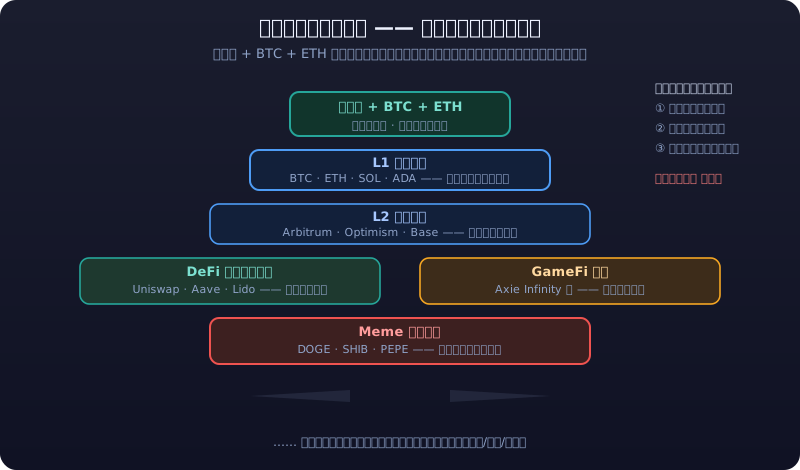
The crypto map: track layering
| Track | What it is | Representatives | Risk profile |
|---|---|---|---|
| Layer1 (L1) | Base-layer chains | BTC, ETH, SOL, ADA | Fierce competition; shifting narratives |
| Layer2 (L2) | Ethereum second-layer scaling | Arbitrum, Optimism, Base | Dependent on the Ethereum ecosystem |
| DeFi | Decentralized finance | Uniswap, Aave, Lido | Contract bug risk |
| GameFi | Blockchain games | Axie Infinity etc. | Extremely short lifecycles |
| Meme | Joke-culture coins | DOGE, SHIB, PEPE | Pure sentiment; high zero-out rate |
- To judge whether a "new narrative" is worth studying, ask three questions first: Are there real users? Is there real revenue? Is the code open-source and auditable? Fail all three and it is pure speculation.
The Exchange Landscape: CEX vs DEX
| Comparison | CEX (centralized exchange) | DEX (decentralized exchange) |
|---|---|---|
| Representatives | Binance, OKX, Coinbase, Bybit | Uniswap, PancakeSwap, Curve |
| Custody | User assets sit in exchange accounts | Assets in the user's own wallet; settled on-chain |
| Experience | Fast, deep, full-featured (futures/yield/lending) | Slow, expensive gas, thin depth |
| KYC compliance | Identity verification required; Coinbase is US-regulated, Binance/OKX hold licenses in various countries (per latest) | No KYC; connect a wallet and go |
| Risks | Platform exit/hacks/regulatory freezes | Smart-contract bugs, slippage, impermanent loss |
- Compliance differences are key: Coinbase is a US-listed company regulated by the SEC; Binance and OKX operate globally but face restrictions in some countries (US users cannot use Binance, per latest regulation); mainland Chinese residents trading on offshore exchanges face legal and cross-border capital risks — be sure to understand local rules yourself.
- "Not your keys, not your coins": assets on a CEX are "the exchange's IOU to you"; they truly belong to you only once withdrawn to a wallet whose private keys you control. Self-custody is recommended for large amounts.
💀 A leaked seed phrase means assets gone forever
"Not your keys, not your coins" — assets on a CEX are "the exchange's IOU to you"; they truly belong to you only once withdrawn to a wallet whose private keys you control. A leaked seed phrase means the assets are gone forever; anyone — person, website, or "customer service" — asking for your seed phrase is a scammer.
- Iron rule for beginners: use only top CEXes + enable two-factor authentication (2FA), and check regulatory licenses and past scandals before registering on any platform.
How to Read On-Chain Data
On-chain data is crypto's unique "charting tool" — every transfer is publicly inspectable, as if the whole world shared one master ledger.
| Indicator | How it's read | Meaning |
|---|---|---|
| Active addresses | Unique addresses interacting on-chain daily | Real usage; sustained rise = healthy ecosystem, sharp drop = users leaving |
| On-chain transfer volume | Coins/amount moved on-chain | Split "exchange-to-exchange" vs "on-chain settlement": large transfers into an exchange = possible selling |
| Exchange net inflow/outflow | Coins flowing in minus out | Net inflow = selling-pressure signal (coins moved to the exchange to sell); net outflow = accumulation signal (withdrawals to self-custody) |
| Stablecoin minting | New USDT/USDC issuance | New issuance = incremental capital entering; large-scale burning = capital leaving |
| Exchange BTC balance | Total BTC on exchange addresses | Multi-year lows = scarce supply (long-term bullish); rebounding = selling pressure returning |
- Practical trick: watch the "whales" (addresses holding large amounts) — a whale moving coins into an exchange often precedes distribution; withdrawals to cold wallets usually signal long-term holding.
- Tools: Etherscan (ETH), Mempool/Blockchain.com (BTC), on-chain analytics platforms (Glassnode, CryptoQuant, etc., per currently available tools).
Market Sentiment Indicators
These three indicators are the "sentiment dashboard" of crypto contract trading, mapping directly to the mechanics of 05 - Crypto Perpetuals / 02 - Funding Rate:
| Indicator | What it is | How to read |
|---|---|---|
| Fear & Greed Index | A composite sentiment score from 0 (extreme fear) to 100 (extreme greed) | Extreme fear (<25) often marks phase bottoms; extreme greed (>75) warns of a pullback |
| Funding rate | The fee exchanged between longs and shorts on perpetuals; positive = longs pay shorts | Persistently high positive rates (e.g., above 0.05%/8h) = longs overcrowded, watch a long squeeze; negative = shorts overcrowded |
| Long/short ratio | The retail long-vs-short account ratio | Extremes (e.g., >2 or <0.8, per platform basis) are often contrarian signals: when retail piles to one side, the market loves to embarrass them |
- Using the three together: Fear & Greed at 90 + funding extremely positive + the ratio one-sided → the classic "overheated triple", a signal to reduce, not to chase.
- Distinguish "retail long/short ratio" from "professional funding rate": in the contract market the average retail position is often right (and the opposite side gets burned) — one reason many veterans use retail indicators as contrarian references.
DeFi Plays and Risks
| Play | What it is | Risk |
|---|---|---|
| Staking | Lock tokens for on-chain yield (e.g., ETH staking, liquid staking via Lido) | Cannot sell during lock-up, validator risk, protocol risk |
| Lending | Post collateral to borrow stablecoins (e.g., Aave, Compound) | Liquidation risk: collateral falling to the threshold triggers auto-liquidation and direct principal loss |
| Liquidity mining (LP) | Provide two-token liquidity to a DEX for fees + token rewards | Impermanent loss: when the two prices diverge, LP returns can lag simply holding |
| Yield aggregators | Automatically route funds to the highest-yielding protocols | Contracts stacked on contracts; when it breaks, no one is accountable |
- DeFi's biggest risk is smart-contract risk: code is law, and hackers simply follow the code. Top protocols have been exploited plenty of times historically (per the latest incidents), and there is no central bank and no insurance.
- "Absurdly high APY" = absurdly high risk: 100%+ annualized risk-free returns do not exist in the real world, and even less so in DeFi.
💀 Absurdly high APY means absurdly high risk
100%+ annualized risk-free returns do not exist in the real world, and even less so in DeFi. High APY is bought with contract risk, depeg risk, and liquidity risk — when the underlying layer breaks, there is no central bank and no insurance; the principal goes to zero with no recourse.
NFT and Meme Coin Risk Warning
| Category | Essence | Risks |
|---|---|---|
| NFT | On-chain digital certificates (images/tickets/membership cards) | Dreadful liquidity, highly emotional pricing; most projects peak "at mint" then die |
| Meme coins | Useless coins driven purely by community sentiment | Violent pumps and dumps, short lifespans, concentrated whale dumps, rug-pull hotbeds |
- One sentence: NFTs and Meme coins are a "lottery market", not an "investment market". Their value is in understanding sentiment and virality; ordinary people should not hold them as asset allocation.
💀 NFTs and Meme coins are a lottery market
NFTs and Meme coins are a "lottery market", not an "investment market". Their value is in understanding sentiment and virality, not as asset allocation for ordinary people; anything that pumps at launch then dumps, or whose contract keeps admin privileges, treat as a scam first.
- Red flags: a new coin "pumping at listing" then dumping, anonymous founders, contracts retaining admin privileges (rule changes/minting), social-media influencers "calling" it — when these combine, treat it as a scam first.
Crypto's Macro Linkage
Crypto is not "a separate planet"; its linkage with macro capital keeps tightening (correlations per latest data):
| Linked variable | Transmission path | What to watch |
|---|---|---|
| Nasdaq | Funds treat crypto as a "high-beta tech asset"; Nasdaq moves often lead or coincide with BTC | Correlation of BTC with the Nasdaq/Philadelphia Semiconductor Index |
| Dollar index | Strong dollar → risk assets broadly pressured; weak dollar → easing-liquidity expectations favor crypto | Windows of DXY-BTC negative correlation |
| Fed rates | High rates → high risk-free returns, money exits risk assets; cut expectations → liquidity easing, crypto's biggest macro tailwind | CME FedWatch probabilities, FOMC meetings |
| Risk appetite (risk-on/off) | When global risk appetite revives, money flows into crypto; in crises it is sold first ("king of risk assets" is also "king of declines") | VIX, S&P 500 trend |
- Practical conclusion: in dollar-liquidity tightening cycles (hikes/QT), every crypto bounce is more likely to be crushed by the macro backdrop; in cutting/liquidity-injection cycles, trend rallies are far more likely.
- Versus gold: both are anti-"dollar credit" proxies, but crypto's volatility and speculative character are far stronger, and its haven property much weaker than gold's (showing up only in isolated sovereign-currency crises).
Beginner Entry Checklist
If you still decide to participate, finish this checklist in order before touching anything:
- Use only legitimate CEXes: mainstream platforms whose sign-up includes KYC (Binance, OKX, Coinbase, etc., as local rules permit), never links from "stock-tip groups" or niche platforms.
- Learn wallets first: before acting, understand that "seed phrase = your entire assets" — the seed phrase must be written out and stored offline; anyone/any site/any "support" asking for it is a scammer.
- Beware airdrop phishing: never click "free tokens", "wallet verification", or "confirm wallet" links; approvals (Approve) are hackers' favorite theft method; touch no unfamiliar links.
- Start small: the first deposit is only "an amount whose total loss changes nothing"; walk the full loop of deposit, withdrawal, buying, selling, and fees first.
- Spot only, at first: contracts, leverage, and DeFi wait at least six months; first learn to "hold the winners and sleep through the losers".
- Withdraw regularly: once the position reaches a meaningful size, withdraw from the CEX to a self-custody wallet (cold storage is better).
- Know local regulations: mainland China has explicit regulatory limits on virtual-currency trading and related activities; verify for yourself and bear the consequences before participating.
Risk Warning
⚠️ Risk Warning
- Crypto has no credit backing and no valuation anchor; price swings are extreme (±20% in a day is not rare), and zero-out risk is real.
- Exchanges, wallets, cross-chain bridges, and DeFi protocols all carry security and operational risk; history has seen top-exchange collapses (FTX etc.) and protocol exploits.
- Contract trading and the funding-rate mechanism (see 05 - Crypto Perpetuals) amplify losses with leverage; after a blow-up the principal is simply gone.
- Stablecoins are not "risk-free dollars": depegging, opaque reserves, and regulatory limits can all break the 1-dollar peg.
- Market-cap shares, fee rates, and index values in this article are teaching-basis — defer to the latest market data; this article does not constitute investment advice.