This is the most important article of the entire futures chapter. The margin system is the engine of futures — and the meat grinder that devours accounts. Forced liquidation / blow-up is the first paid lesson for most futures beginners — except the tuition is usually your entire principal.
Read this as "the safety manual before operating dangerous machinery": work through every formula and every numerical example by hand.
1. The Margin System: The Foundation of Futures
Margin is the collateral frozen in your account to guarantee performance in futures trading. It is not "a down payment"; it is a performance bond — you do not pay the full value, you only prove you can perform.
1.1 Initial Margin
- The minimum funds posted at opening, typically 5%–15% of contract value (varies by product; see the product encyclopedia).
- The exchange sets the baseline rate; the futures firm adds a buffer on top (usually another 2–5 percentage points); the firm's published rate prevails in practice.
1.2 Maintenance Margin
- The minimum equity level that must be maintained while holding, typically 75%–85% of initial margin (for many domestic products, maintenance margin ≈ the exchange baseline).
- As long as equity stays above maintenance margin you can keep the position; once it falls below, the margin-call or forced-liquidation process begins.
1.3 How the Two Margins Relate
Initial margin  ≥  Maintenance margin
Posted at opening     Must be kept while holding
Note: domestic exchanges routinely adjust the "margin rate" dynamically with market conditions and risk (raising it when volatility rises — e.g. overheated markets, before long holidays, near delivery months). When the exchange raises the margin rate, those already holding positions may need to deposit more money immediately.
2. Leverage Multiple: 10% Margin = 10x Leverage
The leverage formula:
Leverage multiple = Contract value ÷ Margin = 1 ÷ Margin rate
| Margin rate | Leverage multiple | Adverse price move | Principal lost |
|---|---|---|---|
| 20% | 5x | 20% | 100% (forced liquidation) |
| 10% | 10x | 10% | 100% (forced liquidation) |
| 7% | ≈14.3x | 7% | 100% (forced liquidation) |
| 5% | 20x | 5% | 100% (forced liquidation) |
Example: 10x Leverage on Rebar
- Rebar price: 3500 CNY/ton, one lot = 10 tons → contract value = 3500 × 10 = 35000 CNY.
- Margin rate 10% → margin at opening = 35000 × 10% = 3500 CNY.
- Leverage multiple = 35000 ÷ 3500 = 10x.
With 3500 CNY you control 35000 CNY worth of goods. Every 1% price move swings your margin account by 10%. This is the mathematical essence of leverage: gains and losses are amplified by the same multiple.
3. Mark-to-Market and Floating P&L
Futures use the mark-to-market (MTM) system: after each trading day's close, the exchange settles P&L on all positions at the daily settlement price (not the close), and gains/losses are credited or debited to the account directly.
Account equity = Available funds + Margin occupied (position value portion)
Daily P&L = (Today's settlement − Open price / yesterday's settlement) × Contract multiplier × Lots held
Example: Three Days Holding One Lot of Rebar Long
Setup: deposit 10000 CNY, go long 1 lot at 3500 CNY/ton, margin 3500 CNY.
| Trading day | Settlement | Daily P&L | Equity | Margin occupied | Available funds |
|---|---|---|---|---|---|
| Opening day | 3500 | 0 | 10000 | 3500 | 6500 |
| Day 1 | 3600 | +1000 | 11000 | 3500 | 7500 |
| Day 2 | 3450 | -1500 | 9500 | 3500 | 6000 |
| Day 3 | 3400 | -500 | 9000 | 3500 | 5500 |
Key points:
- Profits land the same day (available funds increase) and can be withdrawn or used to open new positions — the mechanical basis of "adding on floating profits" in futures.
- Losses are debited the same day; floating losses become real losses immediately, unlike stocks where it is "just on paper".
- As long as equity stays above maintenance margin the system lets you hold; below it, the margin-call/forced-liquidation process begins.
The fundamental difference from stocks: a stock's floating loss exists only on paper — as long as you do not sell, you can still come back; a futures floating loss is "realized" daily, and once equity breaks the margin floor, you lose the right to wait for a rebound.
💀 Futures Losses Are Realized Daily — No Right to Wait for a Rebound
A futures floating loss is "realized" day by day; once account equity breaks the margin floor, you lose the right to wait for a rebound. The fundamental difference from stocks: a stock's floating loss stays on paper, while a futures loss debits your account and becomes a real outflow immediately.
4. Forced Liquidation (Blow-Up) Mechanics in Detail
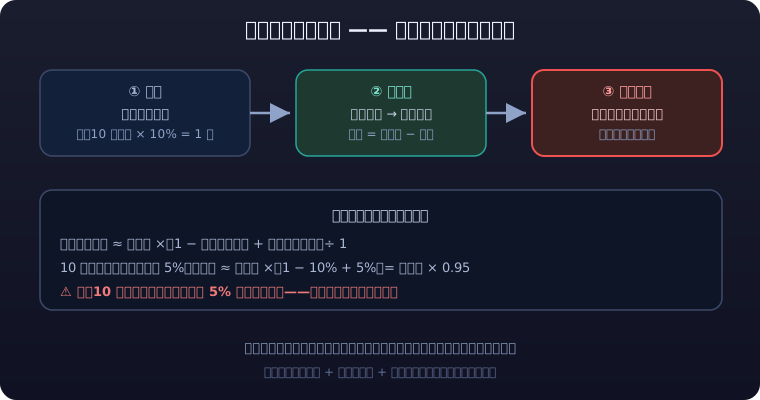
4.1 What Is Forced Liquidation
Forced liquidation (Liquidation / Force Close), colloquially blowing up, means that when account equity is insufficient to maintain position margin, the futures firm (or exchange) forcibly closes part or all of your positions without your authorization, to reclaim the "credit line" extended to you.
4.2 Trigger Conditions and Equity Calculation
Account equity = Available funds + Position margin (at current price)

Margin call triggered: Account equity < Maintenance margin × Lots held
Forced liquidation triggered: Available funds < 0 (equity below current margin requirement)
Typical process (common domestic futures-firm rules):
- Warning line: Available funds turn negative or equity breaks maintenance margin → the firm sends a margin-call notice requiring a top-up within a deadline (usually before today's close or before 9:00 next day).
- Liquidation line: Deadline missed → the firm has the right to liquidate on its own, starting with profitable positions and non-dominant-contract positions, until available funds turn positive again.
- Blow-up line (negative balance): A market gap or drained liquidity leaves losses exceeding equity even after liquidation → the account goes negative — a negative-balance blow-through (see Section 5).
4.3 Liquidation Order
The usual sequence futures firms follow when liquidating (varies by firm; the contract governs):
| Order | Closed first | Reason |
|---|---|---|
| 1 | The most losing positions | Stop the bleeding fast, cut risk exposure |
| 2 | Non-dominant / near-delivery contract positions | Poor liquidity, special rules, high risk |
| 3 | Positions with the highest margin occupation | Free the most margin space |
| 4 | Profitable positions (last resort) | Protect floating profits, but winners may get closed too |
4.4 The Brutality of the Process
💀 Liquidation Is Not a Negotiation — Do Not Expect a Clean Escape in Extreme Markets
- Once the notice is issued, the futures firm has the right to execute immediately, whether or not you have time to react.
- In extreme markets (consecutive limit boards, liquidity evaporation), you cannot close the position yourself even if you try — you can only queue for liquidation.
- When the whole market is blowing up, sell orders stack up and prices punch through multiple levels instantly; the final fill is often far worse than your stop-loss price.
Example: A Full Forced-Liquidation Walk-Through
- Account equity: 10000 CNY, margin rate 10% (maintenance margin 8%).
- One lot of rebar (10 tons/lot) at 3500 CNY → initial margin 3500 CNY, maintenance margin 2800 CNY.
- Margin occupied at opening 3500 CNY, available funds 6500 CNY.
When price falls 650 CNY/ton (−18.6%):
📖 Click to expand: the full three-step derivation of the liquidation price
Loss = 650 × 10 = 6500 CNY
Account equity = 10000 − 6500 = 3500 CNY < Maintenance margin 2800 CNY? → Not yet

Price keeps falling to 2820 CNY/ton (cumulative drop 680):
Loss = 680 × 10 = 6800 CNY
Account equity = 10000 − 6800 = 3200 CNY
Maintenance margin = 2820 × 10 × 8% = 2256 CNY → Equity still above maintenance margin

Price falls to 2750 CNY/ton (cumulative drop 750):
Loss = 750 × 10 = 7500 CNY
Account equity = 2500 CNY
Current margin requirement = 2750 × 10 × 10% = 2750 CNY
Available funds = 2500 − 2750 = −250 CNY → Available funds negative → Forced liquidation triggered!
With price down from 3500 to 2750 (−21.4%), your loss has reached 75% of principal and the account shows negative available funds — the futures firm will liquidate here. You cannot hold on for a rebound, because the system "stopped you out" first.
5. Margin Calls and Negative Balances
5.1 Margin Call
Trigger: account equity falls below maintenance margin, or available funds turn negative.
- After receiving the margin-call notice, you must top up to the maintenance/initial margin level within the stated time.
- Do not pay → the firm liquidates directly (see Section 4).
- Pay but the market keeps moving against you → repeated margin calls; the hole grows with every top-up.
⚠️ A margin call is the "warning"; forced liquidation is the "execution". Many beginners assume the notice can be ignored for a while — and receive the liquidation statement while hesitating.
5.2 Negative Balance (Blowing Through the Account)
A negative balance means that after liquidation is complete, losses still exceed all account equity — the account is in the red.
Negative-balance amount = Total loss − Account equity (including the liquidated portion)
Example:
- Equity 10000 CNY, 10% margin rate, long one lot of soybean meal (10 tons/lot, price 3000 CNY → notional 30000 CNY, margin occupied 3000 CNY).
- Next day a surprise event gaps the price down 5% to 2850 CNY/ton (limit down).
- Loss = 150 × 10 = 1500 CNY → equity 8500. Only 30% of your capital is tied up as margin on a single lot, so a 5% price move is far from liquidation — this is what "not fully margined" buys you.
Try a more extreme case — full margin + consecutive gaps:
- Account 10000 CNY, 10% margin, fully margined into one lot worth 100000 CNY (e.g. crude SC: 1000 barrels/lot, price 100 CNY/barrel, margin 10%).
- Price plunges 15% intraday (from 100 to 85):
- Loss = 15 × 1000 = 15000 CNY
- Account equity = 10000 − 15000 = −5000 CNY
- Liquidation fills at 85 → loss 15000 CNY, account owes 5000 CNY.
- That 5000 CNY is a debt you owe the futures firm and must be repaid; otherwise your credit record suffers and you may be sued.
A negative balance = you owe the futures firm money. This is the most terrifying difference between futures and stocks: a stock can at worst go to 0; futures can go negative.
💀 Negative Balance = Owing the Futures Firm Money; Futures Can Lose More Than You Deposited
A negative balance = you owe the futures firm money. This is the most terrifying difference between futures and stocks: a stock can at worst go to 0, futures can go negative — the amount lost beyond your principal is a debt to the futures firm; fail to repay and your credit record suffers, possibly with a lawsuit.
6. Margin Call Calculation Examples
Example 1: Falling Below Maintenance Margin
- Account equity: 80000 CNY
- Position: 2 lots of SHFE copper (5 tons/lot), opened at 70000 CNY/ton
- Margin rate 10%, maintenance margin rate 8%
At opening:
Contract value = 70000 × 5 × 2 = 700000 CNY
Initial margin = 700000 × 10% = 70000 CNY
Available funds = 80000 − 70000 = 10000 CNY
Copper falls to 68000 CNY/ton:
Position P&L = (68000 − 70000) × 5 × 2 = −20000 CNY
Account equity = 80000 − 20000 = 60000 CNY
Maintenance margin requirement = 68000 × 5 × 2 × 8% = 54400 CNY
Equity 60000 > maintenance margin 54400 → position can still be held, but available funds = 60000 − 68000×5×2×10% = 60000 − 68000 = −8000 CNY. Many futures firms set their liquidation line at "available funds negative" — a margin call is already triggered here.
Top-up required = Current margin requirement − Account equity = 68000 − 60000 = 8000 CNY
Example 2: The Exchange Temporarily Raises Margin
- Before the National Day holiday, the exchange raises a product's margin from 10% to 14%.
- You hold 1 lot worth 100000 CNY, previously occupying 10000 CNY of margin.
- After the raise it needs 14000 CNY → even with price unchanged, you must add 4000 CNY.
Long holidays, extreme markets, and approaching delivery months are the high-frequency windows for margin hikes. Fully margined traders are the most easily force-liquidated at such nodes.
7. Position Size and Margin
7.1 The Key Formula
Available funds = Account equity − Σ(current margin of each position)
7.2 Position Size and Volatility Tolerance
Take a 10x-leverage product (price moves X% → equity moves 10X%):
| Margin used as % of account | Effective leverage | Equity change on X% adverse move | Adverse move needed to blow up |
|---|---|---|---|
| 100% (full margin) | 10x | 10X% | ~10% (+ maintenance-margin buffer) |
| 50% | 5x | 5X% | ~20% |
| 25% | 2.5x | 2.5X% | ~40% |
| 10% | 1x | X% | ~100% (forced liquidation nearly impossible) |
Example: Same 10x Product, Different Position Sizes
Account 100000 CNY, rebar 3500 CNY/ton (10 tons/lot, margin 10%), margin per lot 3500 CNY.
- Full margin, 28 lots: occupies 98000 CNY, only 2000 available. A 0.5% adverse move loses 4900 CNY → available funds negative, liquidatable at any moment. One small red candle ejects you.
- Half position, 14 lots: occupies 49000 CNY, 51000 available. A 10% adverse move loses 49000, equity 51000 — barely survives.
- One-tenth position, 3 lots: occupies 10500 CNY. A 10% adverse move loses 10500, equity 89500 — no stress at all.
The essence of position sizing is deciding how much volatility you can survive. The smaller the position, the larger the error budget; full margin = handing life and death to the next tick.
8. Why Higher Leverage Kills Faster
8.1 The Math: 10x Leverage, 10% Adverse Move = Liquidation
- Account 100000 CNY, 10% margin, fully margined into 1000000 CNY of contracts.
- Price moves 10% against you: loss = 1000000 × 10% = 100000 CNY = the entire principal.
- Adding maintenance margin and the margin-call process, in practice the liquidation warning hits at 7%–9% adverse.
Conclusion: at full margin and 10x leverage, a single 10% adverse move is enough to zero the account. Commodity futures routinely post 4%–7% daily limits — two consecutive limit-downs can put a fully margined trader into a negative balance.
8.2 Survival Odds by Leverage
Assume a maximum adverse move of 15% (common in extreme markets):
| Leverage | Loss at full margin on a 15% adverse move | Outcome |
|---|---|---|
| 2x | 30% of principal | Survives, still in the game |
| 5x | 75% of principal | Gravely hurt, near the margin-call line |
| 10x | 150% of principal | Negative balance, owes money |
| 20x | 300% of principal | Deep negative balance |
8.3 High-Frequency Small Bleeds: Leverage's Slow Death
Even without a blow-up, high leverage dies slowly from "compounding frictions":
- Commissions and slippage: With frequent trading, each round trip costs 0.1%–0.3% both ways — at 10x leverage that burns 1%–3% of principal per round trip.
- Margin volatility: When markets turn wild, margin requirements rise, squeezing available funds and forcing position cuts or panic exits.
- Psychological attrition: At high leverage, a ±5% price swing equals ±50% of principal; fear and greed amplify, execution degrades (constant stop-outs, chasing tops and bottoms).
Leverage is an amplifier: it amplifies gains, but also commissions, fear, and the frequency and cost of your mistakes. Most blow-ups do not die in one big market move — they die from the combination of full margin + no stop-loss + repeatedly holding losers.
8.4 Why "Holding and Hoping" Is a Death Sentence in Futures
Holding a losing stock = waiting to break even; holding a losing futures position = waiting for liquidation.
- Buy 1 million of stock, it falls 50%, 500k left — a 100% rally is needed to break even.
- Fully margined into 1 million of futures contracts (100k principal), a 10% fall = principal wiped to zero — "waiting to break even" is not an option.
In futures, a stop-loss is not about "reducing losses" — it is about "keeping the right to keep playing".
9. Beginner Risk-Control Checklist
- First position in any product ≤ 10%–20% of account equity (i.e. keep effective leverage within 1–3x).
- Set the stop-loss before placing the order: the exit level must be fixed before entry; 2%–3% adverse triggers the exit.
- Per-trade loss cap ≤ 2% of total funds: lose twice and you still have 96% of capital to fight on.
- Full margin is forbidden: always keep available funds for margin calls and volatility.
- The product's leverage multiple ≠ the leverage you must use: on a 10%-margin product, you can open with only 10% of your funds, cutting yourself to 1x leverage.
- Stay away from margin calls: receiving one means you are already on the back foot — the most rational move is usually to cut the position, not to add money.
- Reduce positions ahead of margin-hike windows: before long holidays, before delivery months, and during extreme markets.
- Only use money you can afford to lose: leverage-trading capital is "risk capital" by nature — not living expenses, not mortgage money.
Risk Warning
⚠️ Risk Warning
- Margin trading carries high leverage; losses may exceed your principal (after a negative balance, the shortfall must be repaid to the futures firm).
- Forced liquidation is executed by the system/futures firm — it does not wait for your instruction and does not care about your cost basis; in extreme markets the liquidation price may be far worse than your mental level.
- The margin rates and liquidation rules in this article are generic teaching conventions; each firm's execution details (margin-call deadlines, liquidation trigger lines) are governed by your account contract and the latest exchange rules.
- If after reading this you still cannot compute the blow-up price of a trade by yourself, do not open the position. Learn the mechanics on small size and low leverage first.
Summary
- Margin = a performance bond, split into initial and maintenance tiers; the exchange can raise the rate at any time.
- Leverage multiple = 1 ÷ margin rate; 10% margin = 10x leverage.
- Mark-to-market: P&L transfers daily; floating losses become real immediately.
- Forced liquidation = mandatory closing when equity is insufficient, starting with losing positions, until available funds turn positive.
- Negative balance = still owing the futures firm after liquidation — a debt, not merely "losing everything".
- Position size decides survival odds: full margin at 10x, wiped out by a 10% adverse move; at one-tenth position it takes a 100% move to hurt you.
- Higher leverage kills faster: not a curse, just math.